Research
30 posts tagged.
-

Satellite Lamps
Satellite Lamps is a project about making one of today’s most important infrastructures visible: GPS, the Global Positioning System. We built a series of lamps that change brightness according to the accuracy of the GPS signals they receive. Made with Einar Sneve Martinussen and Jørn Knutsen as part of the YOUrban research project at AHO.
-
Making Visible
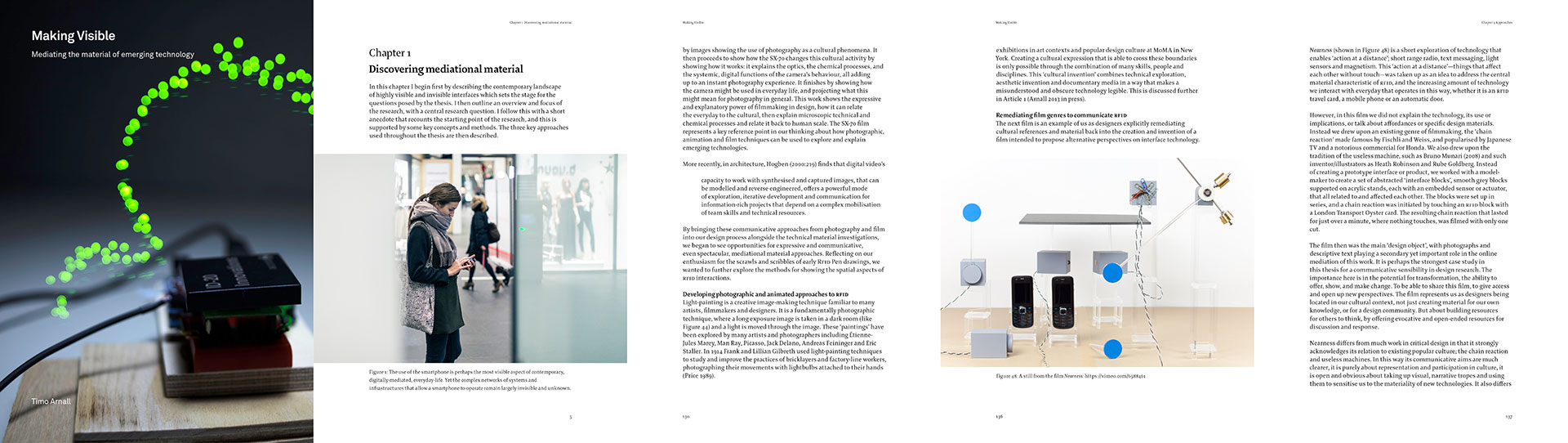
My PhD thesis ‘Making Visible’ was submitted in December 2013 and defended on 12 June 2014. It reflects on the design material exploration research from the Touch and YOUrban projects, situating interaction design with technology as a cultural, material and mediational practice.
-
Internet Machine
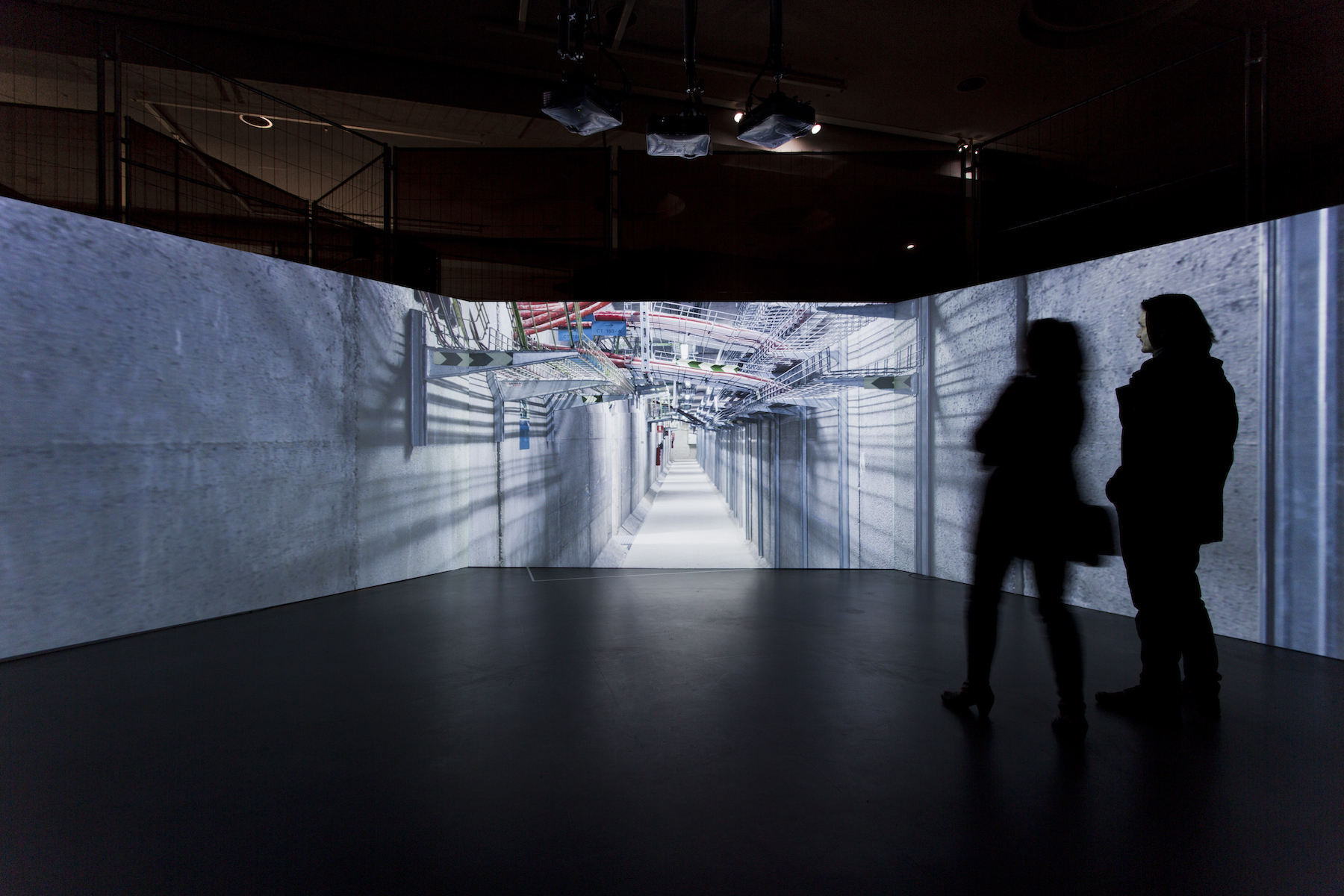
Internet machine is a multi-screen film about the invisible infrastructures of the internet, shot inside one of the largest and most secure data centres in the world, run by Telefónica in Alcalá, Spain. I made it to show the physical reality of our data: the rooms, racks and machines through which ‘the cloud’ is transmitted and transformed.
-
The Immaterials project
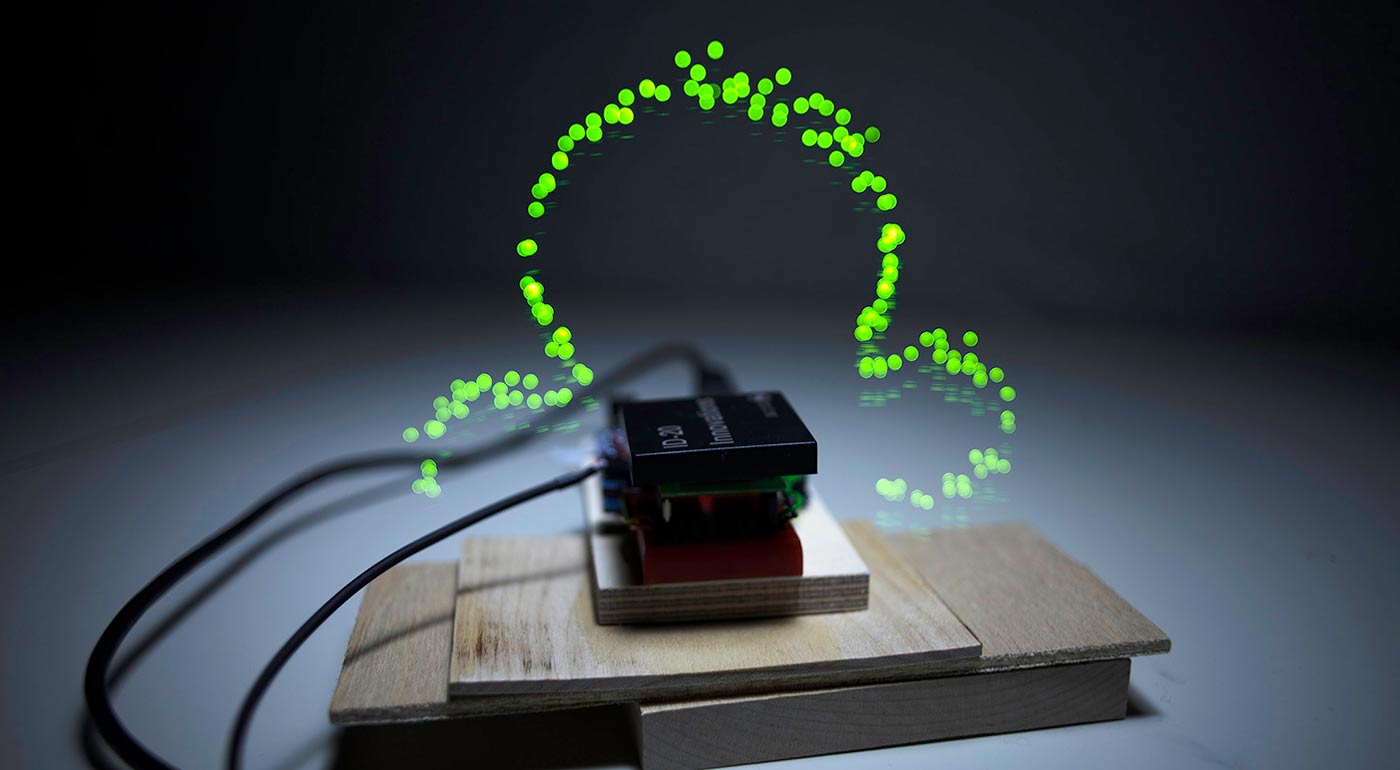
The Immaterials project is about the growing invisibility of the interfaces and infrastructures around us. An overview of five years of work with Einar Sneve Martinussen, Jørn Knutsen, Jack Schulze and Matt Jones, showing the shape and workings of these infrastructures through photography, animation, narrative and film.
-
Robot Readable World
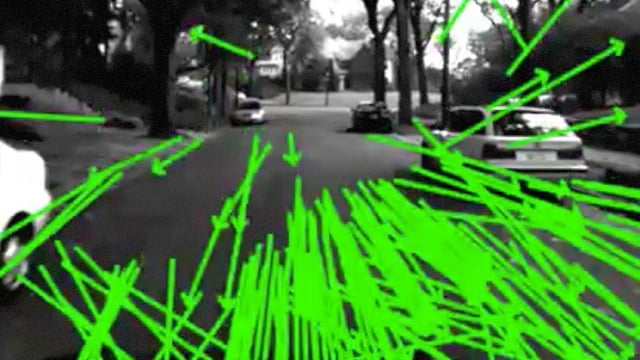
A short film, an experiment with machine-vision footage, pulled together from computer vision research: face detection, motion tracking, object recognition, scanning. A glimpse of the world as cameras and algorithms register it.
-

The future is Movie OS
A note on Dan Hon’s Movie OS piece. The idea that Apple is grasping at real-life objects because they support effective visual storytelling is very interesting. Hon argues that visual storytelling hardly exists at all in computer or consumer electronics user interfaces.
-
Things
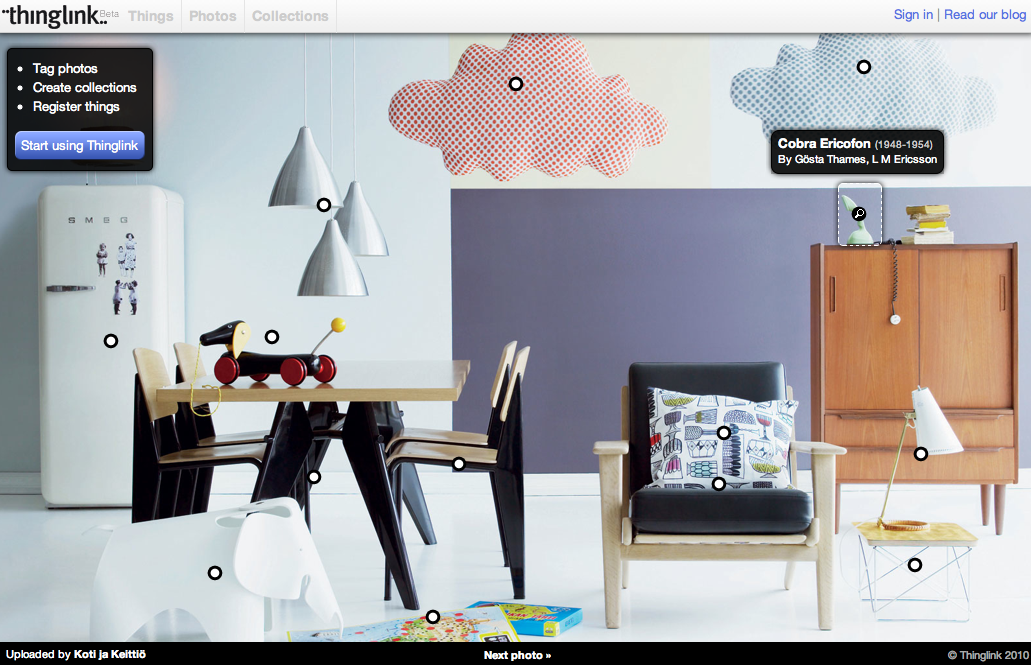
A short note on a cluster of emerging ‘things’ services in early 2010. Thinglink’s exploratory homepage, SVPPLY’s continuous navigation of want, and related services like Thingd and Allconsuming.
-
Touch
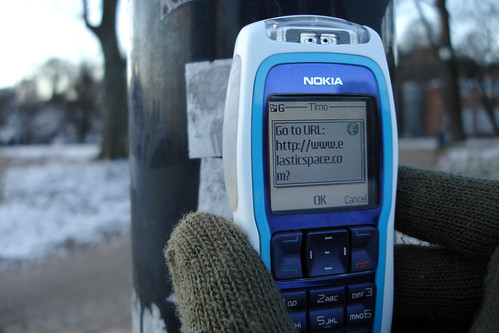
An AHO research project on what designers should do with NFC. Touch a phone to a tag, the tag answers, something happens. A phone call, an SMS, a URL. Funded by the Research Council of Norway, running since March 2006 with a project weblog at nearfield.org.
-
Augmented reality experiments
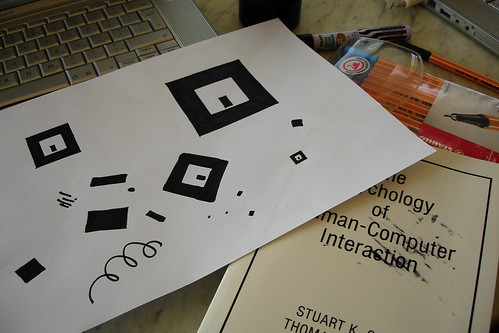
An afternoon with Even Westvang and ARtoolkit, the open-source library for augmented reality markers. No printer handy, so we drafted the markers by hand, stencilling them off the screen with a pencil and inking them in, and confused ARtoolkit by drawing them in perspective.
-
You are here
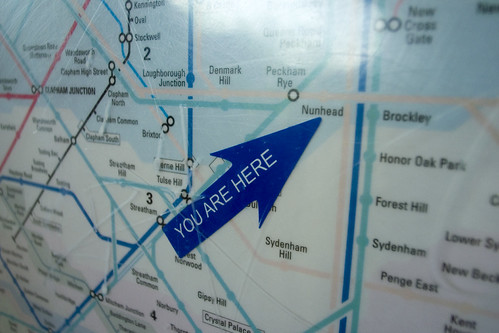
A 2006 note on collecting images of ‘you are here’ marks, or ideo locators, at Flickr. The relationship to local physical space is what makes them work: mapping with a point of view, maps as a direct interface to the world. The best example to date is from Seoul, where 3D cross sections of a metro station are directly related to the point at which you are looking at the map.
-
The address book desk
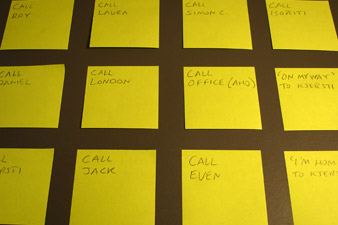
An early Touch-project experiment from December 2005. A grid of RFID tags stuck under the desk, mirrored by a grid of post-it notes on the surface, a phone-book, to-do list and temporary diary in one. Touching the phone to each post-it calls a contact, sends a pre-defined SMS or opens a URL.
-
Nokia 3220 with NFC
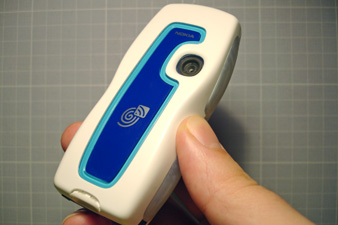
A prototype Nokia 3220 NFC shell has been on loan from Matt Jones at Nokia for a few weeks. Touch it to a tag, the phone vibrates sharply, a light flashes, and something happens, a phone call, a web page, an SMS. It’s the second Nokia phone with an RFID reader-writer, and it is solid enough to build with.
-
Embodied interaction in music
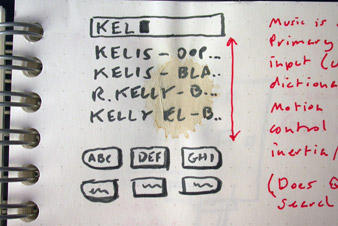
A set of sketches from Easter 2005 on navigating music on portable devices, written after switching from a 40GB iPod to the iPod Shuffle. The clickwheel doesn’t cut it on huge alphabetical lists. The sketches try predictive text input, squeeze-and-shake movement, audio scrubbing and gestures like covering an ear to switch tracks.
-
Tangible and social interaction
On a Nintendo DS in a café, two people are sending each other stick-figure drawings over PictoChat. On a TV in someone’s living room, four people are singing along to Singstar and making each other worse at it. At a bus stop in Berkeley, a phone is quietly logging which other phones it’s been near over the course of a day, a map of familiar strangers. Two lectures given at AHO in Oslo in January 2005, arguing that tangible and social interaction are the next chapter after the desktop. The PDF of the full presentation is here (1.9MB). Posted partly in response to Matt Jones and Chris Heathcote ‘s ETech presentation ( notes , link restored from Wayback). (Based on Dourish, see reading recommendations below.) Each successive development in computer history has made greater use of human skills: Electrical : required a thorough understanding of electrical design Symbolic : required a thorough understanding of the manipulation of abstract languages Textual : text dialogue with the computer, which set the standards of interaction we still live with today Graphic : graphical dialogue with the computer, using our spatial skills, pattern recognition, and motion memory with a mouse and keyboard
-
Sound objects
A box sits on the desk, with no markings on its surface. Touch it with a finger and the box makes a sound, impact, friction, deformation, depending on where you touch. There are soft buttons on the surface, but you can’t see them. You hear them. Notes from Mikael Fernström’s lecture at AHO in February 2005. Fernström runs the Interaction Design Centre at the University of Limerick, where the Soundobject project is working on sound in ubiquitous computing, a relatively unexplored area of interaction design. The aim of the Soundobject research is to liberate interaction design from visual dominance, to free up the eyes, and to do what small displays don’t do well. Sound is currently under-utilised in interaction design Vision is overloaded and our auditory senses are seldom engaged In the world we are used to hearing a lot Adding sound to existing, optimised visual interfaces does not add much to usability Sound is good at attracting attention, which is why alarms and notification systems work. We talked about ‘caller groups’ on mobile phones, assigning different ringtones to people in an address book, and how effectively that changes our relationship with our phones.
-

Spatial memory at Design Engaged 2004
Presentation notes from Design Engaged 2004 in Amsterdam. Two related strands: the Time that land forgot project with Even Westvang (five months, 8000 photos, visualised by date and time of day), and the research on marking in urban public space.
-
Design Engaged 2004
Twenty-odd designers, researchers and writers sat around a long table in Amsterdam over a weekend in November 2004, taking turns to present. These are my notes, session-by-session, as written at the time. Design Engaged 2004 was an invitation-only gathering organised by Andrew Otwell. A small, intense weekend of conversation that turned out to be one of the generative moments of the design-web at that period. The FAQ has the full list of attendees. There are also lots of photos on Flickr . The growth of the soil How do we comprehend complexity How do we build structures around complex information Accreting meta-data: GPS data, descriptive information Break down of material as it hits the soil Soup, tags, condensed and distilled meta objects Sorting mechanisms, affinity browsers, related, filtering, emergent relationships, interrelationships How do we conceive a metaphor for building these processes? A structure that is meaningful for the users. Application design: movement through states of application to tending a flow of processes Tending to meta-data is a growth process DLA: diffusion-limited aggregation, a natural process model The relationships between metadata can be visualised as this.
-
Art + communication 2004
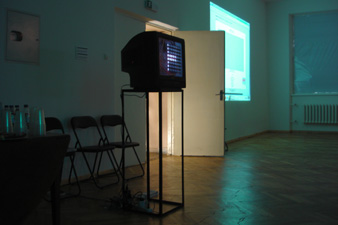
Notes from Art + Communication 2004, organised by RIXC in Riga, Latvia, the final event in the Trans-cultural Mapping workshop series. Even Westvang and I presented our Timeland project. A trip to Limbazi for the opening of the Piens (‘milk’) project, milk routes through the EU, mapped through the personal stories of the people along them.
-
Design research books
This is one of a series of reading lists I put together between 2002 and 2004 when I was starting out in interaction and experience design, building out a personal canon from books I was buying, borrowing from libraries, or lending to students. The lists are grouped by topic. This is the last and shortest list on the shelf, the one on design research as a practice. Norman Potter’s What is a designer and Models and Constructs are the two books that deserve to be read more than they are, compact, sharp and more relevant to design education than most larger textbooks. Brenda Laurel’s Design Research: Methods and Perspectives is the practical anthology. Miller & Lupton’s Design Writing Research is the critical and editorial companion, how design thinking becomes design writing. The Amazon links below are what I had at the time, most will be dead now, but the ISBNs will find you a copy. Norman Potter. amazon.co.uk / amazon.com Norman Potter. amazon.co.uk / amazon.com Brenda Laurel Ed. amazon.co.uk / amazon.com Abbott Miller, Ellen Lupton. amazon.co.uk / amazon.com Jessica Helfand. amazon.co.uk / amazon.com
-
Geo-referenced photography
The simplest way to link a photograph to a location is to combine two time-stamps: one from the digital camera, one from the GPS receiver. Given both sets of timestamps over the same period, a series of images and tracklogs can be processed to stamp each image with location metadata. Compiled in July 2004 at the Hofn workshop in Iceland, during the work that became Time that land forgot . A working reference list of papers, projects, guidelines, tools and the technical issues that surrounded geo-referenced photography at that moment. Most of the links below are now dead; the list is preserved as a snapshot of what the state of the art looked like in 2004. Position-annotated Photographs: The Geotemporal Web GEOREP: Digital Library for Spatial Data Geographic location tags on digital images, Microsoft Portable digital photo album Tokyo Picturesque ( details ) Habitat Perspectives Photo Location ( metadata notes ) Geo Snapper WWMX web demo Good list of other photo mapping projects Commercial applications and scripts that link photographs to geographic information: Robophoto 93 Photo Street Photofusion Media Mapper OziPhotoTool GPS photo link GPS TrackMaker QuakeMap WWMX Travelogue app…
-

Spatial annotation projects
A reference list I compiled in June 2004 during early PhD research into locative media and spatial annotation. It includes Murmure in Vancouver’s Chinatown, Yellow Arrow stickers, Grafedia’s hyperlinked handwritten text, Urban Tapestries and dozens of others. The list is preserved as a snapshot of a field at a particular moment.
-
Transcultural mapping workshops
A brief announcement from May 2004. Two workshops on the calendar this summer. The Transcultural Mapping workshop (‘Mobile outskirts: cultural mapping of northern geographical outposts’), in Lofoten in June, looking at GPS and photography in remote Norwegian coastal places. The Loop City workshop at the Outside In symposium (‘Emerging expressions, interventions and participation in public space’) in Gothenburg shortly after, on walking and mapping urban public space with Bill Hillier of Space Syntax. Update: new workshop website .
-
Adaptive design books
This is one of a series of reading lists I put together between 2002 and 2004 when I was starting out in interaction and experience design, building out a personal canon from books I was buying, borrowing from libraries, or lending to students. The lists are grouped by topic. This one is on adaptive design: emergence, pattern languages, the design of things that learn or evolve, and the classics on how cities and communities organise themselves. Christopher Alexander is the spine of this shelf, from Notes on the Synthesis of Form through A Pattern Language to The Nature of Order. Stewart Brand’s How Buildings Learn is the architectural companion. Jane Jacobs’s Death and Life of Great American Cities is the urban-planning foundation. Steven Johnson’s Emergence and Mitchel Resnick’s Turtles, Termites, and Traffic Jams are the approachable modern introductions to complex adaptive systems. Rheingold’s Smart Mobs is the early-2000s prediction of networked collective behaviour that mostly came true. The Amazon links below are what I had at the time, most will be dead now, but the ISBNs will find you a copy. Christopher Alexander. amazon.co.uk / amazon.com Christopher Alexander. amazon.com
-
Architecture theory books
This is one of a series of reading lists I put together between 2002 and 2004 when I was starting out in interaction and experience design, building out a personal canon from books I was buying, borrowing from libraries, or lending to students. The lists are grouped by topic. Architecture is the parent discipline of a lot of interaction design thinking, and this list is the shelf I was reading on the theory side: space, the city, urbanism, and the politics of the built environment. Calvino’s Invisible Cities is the book I keep giving to people. Bachelard’s Poetics of Space is the phenomenological counterpart, both are worth reading slowly. Bernard Tschumi’s Architecture and Disjunction and Manhattan Transcripts are the most polemical of the theoretical books. William J. Mitchell’s City of Bits and E-topia are the early digital-urbanism texts that most directly speak to interaction designers working on networked spaces. The Amazon links below are what I had at the time, most will be dead now, but the ISBNs will find you a copy. M. Christine Boyer. amazon.co.uk / amazon.com Nick Barley. amazon.co.uk / amazon.com Manuel Gausa. amazon.co.uk / amazon.com Norman Foster. amazon.co.uk / amazon.com
-
Design management books
This is one of a series of reading lists I put together between 2002 and 2004 when I was starting out in interaction and experience design, building out a personal canon from books I was buying, borrowing from libraries, or lending to students. The lists are grouped by topic. This one is the shortest on the shelf and the most practical, the books on managing design projects, gathering requirements and running workflows. The Robertsons’ Mastering the Requirements Process is the standard reference on requirements gathering. Karl Wiegers’s Software Requirements is the software-engineering equivalent. Goto & Cotler’s Web Redesign is of its moment but it was the manual every web-design studio had on a shelf in 2003. The Amazon links below are what I had at the time, most will be dead now, but the ISBNs will find you a copy. Suzanne Robertson, James Robertson. amazon.co.uk / amazon.com Karl E. Wiegers. amazon.co.uk / amazon.com Jessica Burdman. amazon.co.uk / amazon.com Kelly Goto, Emily Cotler. amazon.co.uk / amazon.com Steve McConnell. amazon.co.uk / amazon.com
-
Usability books
This is one of a series of reading lists I put together between 2002 and 2004 when I was starting out in interaction and experience design, building out a personal canon from books I was buying, borrowing from libraries, or lending to students. The lists are grouped by topic. This one is on usability, the discipline that gave interaction design its empirical grounding. Don Norman’s The Design of Everyday Things is the foundational book, and still the one to read first. Steve Krug’s Don’t Make Me Think is the approachable practitioner’s companion. Beyer & Holtzblatt’s Contextual Design is the canonical research-methods book, the one that taught a generation of designers how to watch users in their actual contexts. Nielsen is the dominant figure of the era, for better and worse; both his books are worth knowing even where you disagree. The Amazon links below are what I had at the time, most will be dead now, but the ISBNs will find you a copy. Donald Norman. amazon.co.uk / amazon.com Donald Norman. amazon.co.uk / amazon.com Douglas K. Van Duyne, James Landay, Jason I. Hong. amazon.co.uk / amazon.com John Cato. amazon.co.uk / amazon.com Hugh Beyer, Karen Holtzblatt. amazon.co.uk / amazon.com
-
Game design books
This is one of a series of reading lists I put together between 2002 and 2004 when I was starting out in interaction and experience design, building out a personal canon from books I was buying, borrowing from libraries, or lending to students. The lists are grouped by topic. This one is on game design, a discipline with a lot to teach interaction designers about engagement, feedback and the design of systems people come back to. Salen & Zimmerman’s Rules of Play is the canonical theoretical text; it did for game design what Bordwell & Thompson did for film. Steven Poole’s Trigger Happy is a cultural rather than technical take, and one of the better-written books on games. Lucien King’s Game On was the Barbican’s 2002 exhibition catalogue, still a useful visual and historical overview. The rest are practical manuals from the pre-indie era of game development. The Amazon links below are what I had at the time, most will be dead now, but the ISBNs will find you a copy. Katie Salen, Eric Zimmerman. amazon.co.uk / amazon.com Bob Bates. amazon.co.uk / amazon.com Andrew Rollings, Ernest Adams. amazon.co.uk / amazon.com Andrew Rollings, Dave Morris. amazon.co.uk / amazon.com Lucien King. amazon.co.uk / amazon.com
-
Business and strategy books
This is one of a series of reading lists I put together between 2002 and 2004 when I was starting out in interaction and experience design, building out a personal canon from books I was buying, borrowing from libraries, or lending to students. The lists are grouped by topic. This one is short: the business and strategy books I was reading to understand where design sits in the wider commercial conversation. Christensen’s The Innovator’s Dilemma is the single most useful book here. The Experience Economy by Pine & Gilmore is the strategic framing most relevant to experience design; it made the argument that experience itself is the product. The rest are either IDEO-perspective (Kelley) or of their moment (the Dream Society and Experiential Marketing). The Amazon links below are what I had at the time, most will be dead now, but the ISBNs will find you a copy. Tom Kelley. amazon.co.uk / amazon.com Clayton M. Christensen. amazon.co.uk / amazon.com Rolf Jensen. amazon.co.uk / amazon.com B. Joseph Pine. amazon.co.uk / amazon.com Bernd H. Schmitt. amazon.co.uk / amazon.com
-
Technical books
This is one of a series of reading lists I put together between 2002 and 2004 when I was starting out in interaction and experience design, building out a personal canon from books I was buying, borrowing from libraries, or lending to students. The lists are grouped by topic. This one is the shortest, and the most time-stamped: the technical books I was reading when web standards, CSS and accessibility were still being argued over. Much of this has since become second nature or been superseded, but at the time these were the books shaping the craft. Zeldman’s Designing with Web Standards is the generational text of that moment, the book that made the case for separating structure from presentation and won the argument. Eric Meyer on CSS and Håkon Wium Lie’s book on CSS1 are the practical and theoretical companions. Joe Clark’s Building Accessible Websites is the conscience of the shelf. The Amazon links below are what I had at the time, most will be dead now, but the ISBNs will find you a copy. Jeffrey Zeldman. amazon.co.uk / amazon.com Jeffrey Zeldman. A fantastic how-to book for designers looking to get involved in web publishing and design. Takes the reader through writing, usability, architecture and technical tips. amazon.co.uk / amazon.com
-
Narrative books
This is one of a series of reading lists I put together between 2002 and 2004 when I was starting out in interaction and experience design, building out a personal canon from books I was buying, borrowing from libraries, or lending to students. The lists are grouped by topic. This one is on narrative: interactive storytelling, theatre as a model for interaction, story structure, and the sequential-art tradition of comics. Janet Murray’s Hamlet on the Holodeck and Brenda Laurel’s Computers As Theatre are the two foundational texts that frame interaction design as a narrative practice. Campbell’s The Hero with a Thousand Faces is the story-structure canon. And Scott McCloud’s Understanding Comics, along with Eisner’s books, are among the most useful things an interaction designer can read, more practical than most HCI books for thinking about pacing, framing, and the relationship between words and images. The Amazon links below are what I had at the time, most will be dead now, but the ISBNs will find you a copy. Janet H Murray. amazon.co.uk / amazon.com Mark Stephen Meadows. amazon.co.uk / amazon.com Brenda Laurel. amazon.co.uk / amazon.com Joseph Campbell. amazon.co.uk / amazon.com