Making Visible
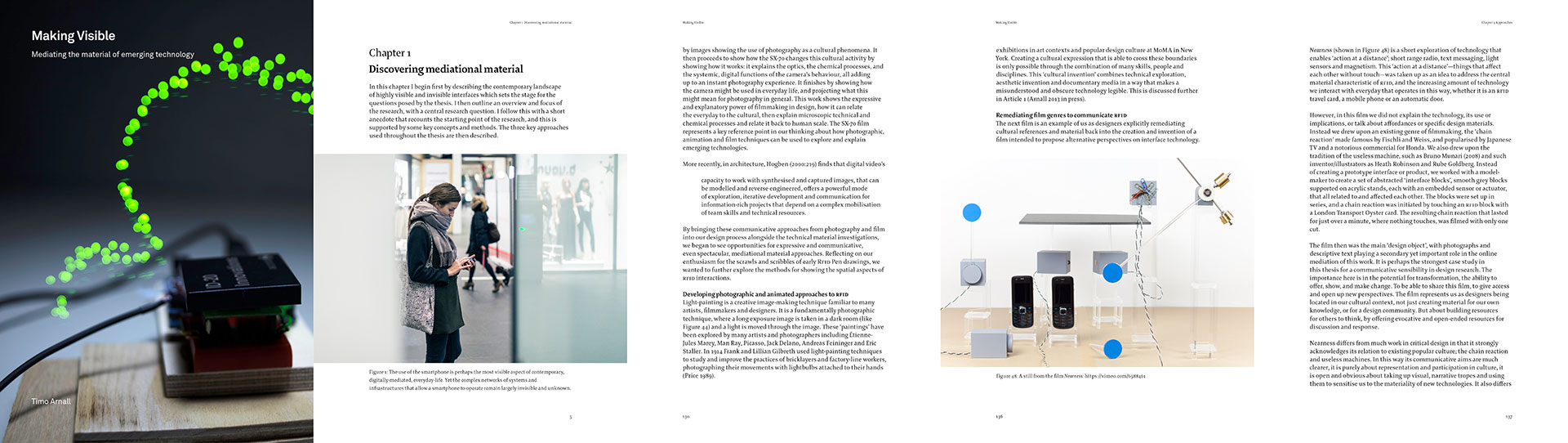
My PhD thesis called ‘Making Visible’ was submitted in December 2013 and successfully defended on 12 June 2014. The thesis reflects upon the design material exploration research from the Touch and YOUrban projects. It uses these explorations to situate design research with technology as a cultural, material and mediational practice:
In Making Visible I outline how interaction design may engage in the material and mediation of new interface technologies. Drawing upon a design project called Touch, that investigated an emerging interface technology called Radio Frequency Identification or RFID, I show how interaction design research can explore technology through material and mediational approaches. I demonstrate and analyse how this research addresses the inter-related issues of invisibility, seamlessness and materiality that have become central issues in the design of contemporary interfaces. These issues are analysed and developed through three intertwined approaches of research by design: 1. a socio- and techno-cultural approach to understanding emerging technologies, 2. through material exploration and 3. through communication and mediation. When taken together these approaches form a communicative mode of interaction design research that engages directly with the exploration, understanding and discussion of emerging interface technologies.
The thesis is made up of four peer-reviewed journal articles accompanied by a ‘meta-reflection’ document that reflects upon and situates these publications through theory, concepts and models.
Overview
This document develops the concept of mediational material that focuses attention on the material and communicative practices in interaction design. These are used to explore, develop and share knowledge of technologies as design materials.
I’ve made it available in a number of different digital formats:
- Download as PDF (7MB)
- Download as ePub (14.4MB)
- Read it on Kindle (US, UK)
It will also be available through AHO’s open-access archive ADORA.
Articles
The four included articles have been published in peer-reviewed journals.
Article 1: Exploring ‘immaterials’: mediating design’s invisible materials
This article takes up the issues of so-called ‘immaterial’ and ‘seamless’ technologies and asks how designers might explore them in order to consider them as design materials. It situates interaction design as a sociocultural practice that is concerned with culture, critical approaches and with engaging the technocultural imagination. It concludes by analysing its mediational strategies, such as the use of documentary formats, online film and weblog writing, and the ways in which new material perspectives have been shared, discussed and developed by others.
Arnall, T. (in press). ‘Exploring ‘immaterials’: mediating design’s invisible materials’. International Journal of Design, 29. Will be available at the International Journal of Design.
Article 2: Visualizations of digital interaction in daily life
This article explores how visual signage may make aspects of ubiquitous computing technologies visible and how digital tools and platforms impact that visual design and semiosis. It looks at a range of ‘identification’ technologies such as barcodes and RFID, that only become ‘visible’ or ‘interactional’ through a designer’s intervention in physical or visual expression. It finds that designers should emphasize the bindings and distinctions between design processes and visual mediations, and symbols and signs, in engaging with emerging technologies as material for creative and communicative composition.
Morrison, A., & Arnall, T. (2011). Visualizations of Digital Interaction in Daily Life. Computers and Composition, 28(3), 224-234. Available at Computers and Composition.
Article 3: Satellite Lamps
Satellite Lamps is a project about using design to investigate and reveal one of the fundamental constructs of the networked city: GPS - the Global Positioning System. It extends the concepts of ‘mediational materials’ to an investigation of the ways in which GPS technology inhabits urban spaces. The article takes up how a discursive and reflexive interaction design practice can contribute to new perspectives on networked city life. Importantly, Satellite Lamps is a multimediational web text, involving different media (film, media, notebooks and a host of images) allowing for the richness of the work to come to the surface in a way that would not have been possible in traditional means of academic publishing.
Martinussen, E, Knutsen, J & Arnall, T. (forthcoming 2014). Satellite Lamps. Kairos: A Journal of Rhetoric, Technology, and Pedagogy. Will be available at Kairos.
Article 4: Depth of Field: Discursive design research through film
This article is about the role of film in interaction and product design research with technology, and the use of film in exploring and explaining emerging technologies in multiple contexts. It concludes by looking towards the potentials for a discursive design practice, where the object of design and analysis is the discourse that is catalysed by new artefacts, and the emphasis of design research is on communication.
Arnall, T., & Martinussen, E. S. (2010). Depth of field: discursive design research through film. FORMakademisk, 3(1). Available at FORMakademisk.