Interaction Design
45 posts tagged.
-
Project Soli
This film was the result of a multi-year design project with Google. Project Soli developed a new interaction sensor using radar technology, in order to find new kinds of interactions with products.
-
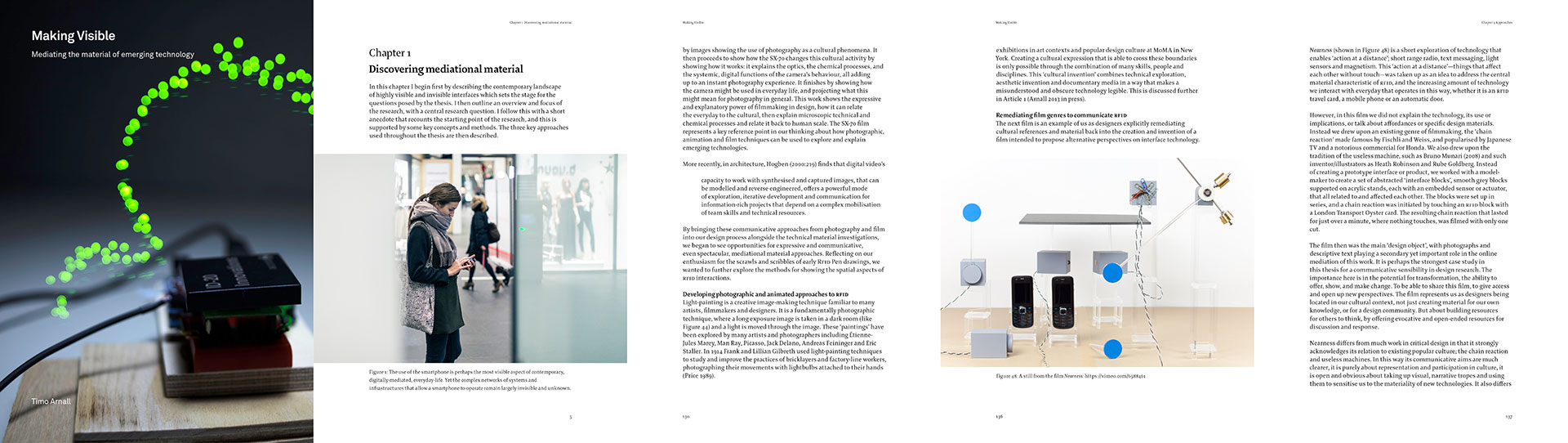
Making Visible
My PhD thesis ‘Making Visible’ was submitted in December 2013 and defended on 12 June 2014. It reflects on the design material exploration research from the Touch and YOUrban projects, situating interaction design with technology as a cultural, material and mediational practice.
-
Pixel Track
Original film no longer hosted by Vimeo. Open in Wayback Machine . Pixel Track is a prototype of a new kind of connected display, produced by Berg in collaboration with the Future Cities Catapult. More…
-
Cloudwash
Cloudwash is a prototype washing machine that was made to explore how connectivity might change the ordinary appliances in our homes. Made at BERG and designed by Durrell Bishop . More…
-
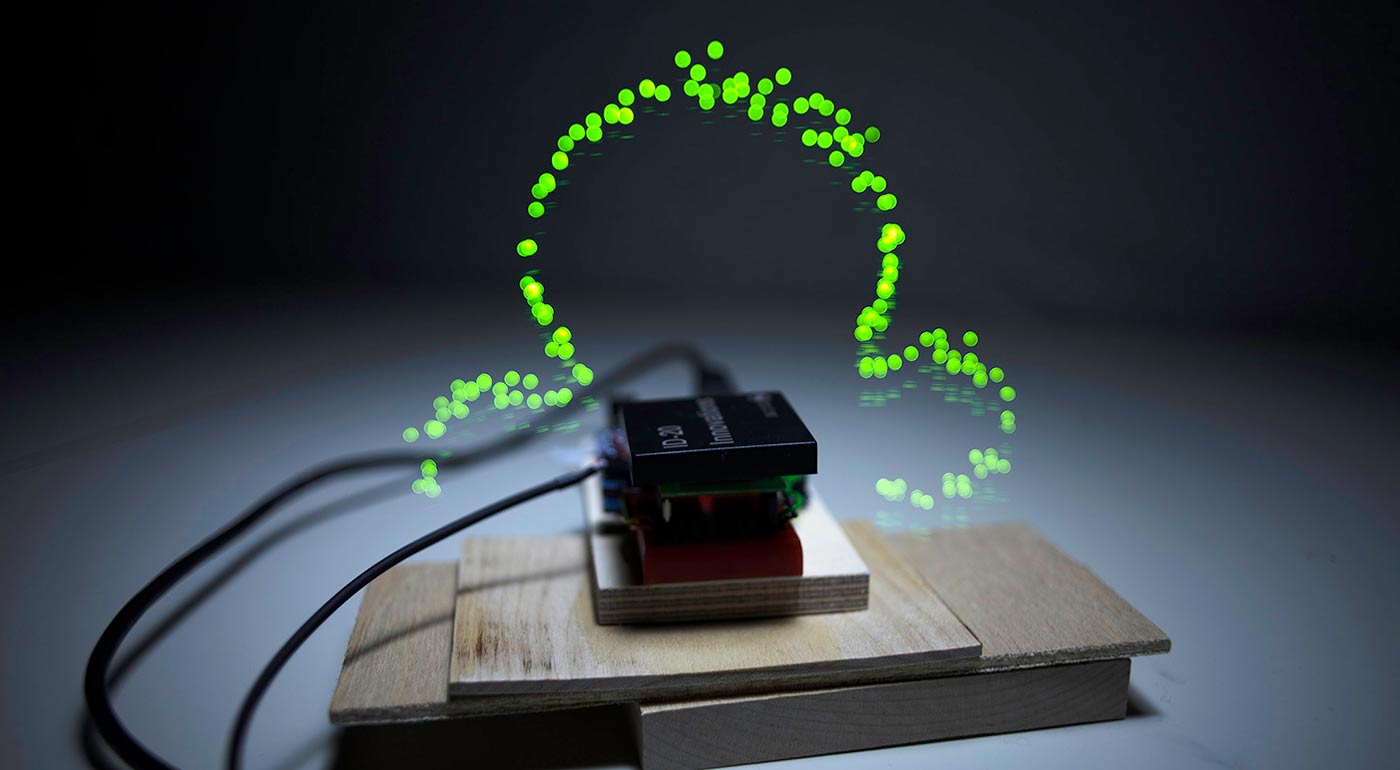
The Immaterials project
The Immaterials project is about the growing invisibility of the interfaces and infrastructures around us. An overview of five years of work with Einar Sneve Martinussen, Jørn Knutsen, Jack Schulze and Matt Jones, showing the shape and workings of these infrastructures through photography, animation, narrative and film.
-
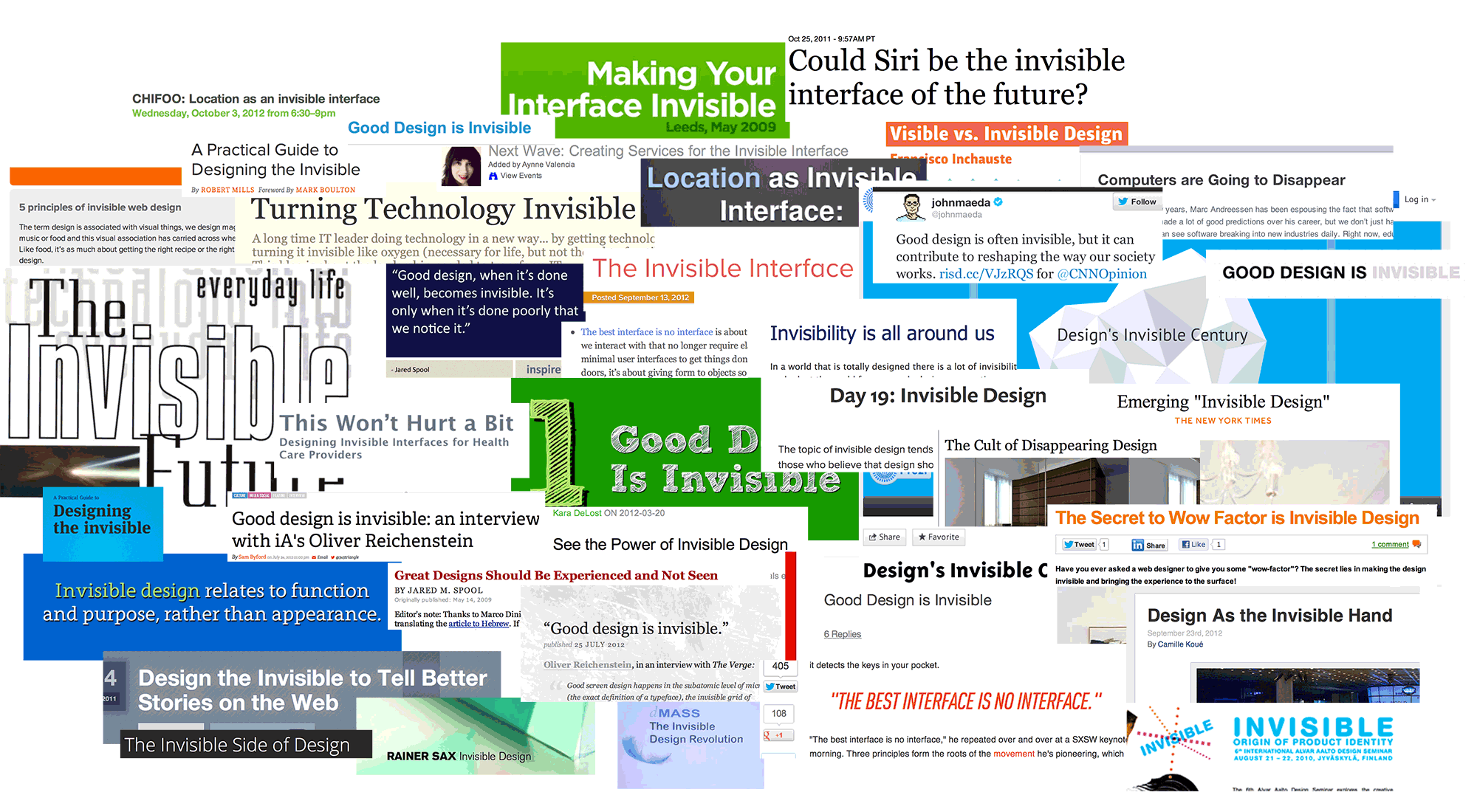
No to NoUI
‘The best design is invisible’ is the interaction design phrase of the moment. This is a critique of the NoUI movement: we must abandon invisibility as a goal for interfaces. It’s misleading, unhelpful, dishonest.
-
Little Printer
Little Printer lives in your home, bringing you news, puzzles and gossip from friends. Use your smartphone to set up subscriptions and Little Printer will gather them together to create a timely, beautiful mini-newspaper. More…
-
Talk to Me
I have five works in MoMA ’s latest exhibition ‘ Talk to Me ’ in New York. The works are Nearness , Immaterials , Media Surfaces , The Journey and Suwappu . I have written more about the exhibition and the works at the Touch and BERG weblogs. The exhibition has also been reviewed by CNN , the New York Times , Fast Company and the Wall Street Journal amongst others .
-
Connecting the digital world with print
A rare piece of writing from Durrell Bishop : Read the whole thing: Connecting the digital world with print .
-
A phone to save us from our screens?
Microsoft has two new ads, anticipating their upcoming Windows Phone 7 launch. The first is an almost post-apocalyptic vision of humanity stuck with their heads in their mobile devices: Here’s David Webster , chief strategy officer in Microsoft’s central marketing group, explaining their anti-screen strategy: The problem of glowing rectangles is a subject close to my heart , and Matt Jones has been bothered by the increase in mobile glowing attention-wells . I think Microsoft & Crispin Porter + Bogusky’s advertising strategy stands out in a world full of slick floaty media . The only problem is that without any strategy towards tangible interaction, I’m not sure the ‘tiles’ interaction concept is strong enough to actually take people’s attention out of the glass.
-
Olars: physical toy inspired by karl sims evolved creatures
A lovely piece of work by Lars M. Vedeler and Ola Vågsholm from the Tangible Interactions course at The Oslo School of Architecture & Design: Olars on Vimeo
-
3D secret – hidden pictures
Beautiful new exploratory game for the Nintendo DS, that uses the front-facing camera and face tracking to calculate a perspective that renders like a window on a new world. DSi「立体かくし絵 アッタコレダ」(Looksley’s Line Up) . Via BERG
-
Augmentia
Anselm Hook , one of the founding thinkers of the geo-web, co-organiser of the first ARDevCamp at the Hacker Dojo in Mountain View late last year, lays out the emerging issues with Augmented Reality. He relates it to a whole host of known and unknown problems around ubiquitous computing, semantic publishing and data platforms. A few passages worth holding on to:
-
iPhone RFID: object-based media
Touch the iPhone to a record sleeve and the album plays. Touch it to a book and the cover loads. The film tries out RFID as a way of binding media to the physical objects that already live next to a reader. Made as part of the Touch project . More…
-
Map/Territory
A short visual experiment that shows physical space overlaid with digital, manipulable map information.
-
Woodwork
A glimpse into the processes of transforming rough wood into sculptural, formed objects. Featuring Matt Cottam .
-
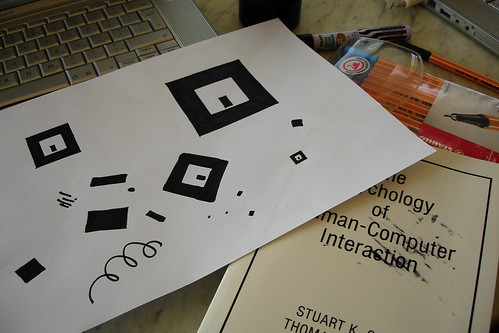
Augmented reality experiments
An afternoon with Even Westvang and ARtoolkit, the open-source library for augmented reality markers. No printer handy, so we drafted the markers by hand, stencilling them off the screen with a pencil and inking them in, and confused ARtoolkit by drawing them in perspective.
-
The address book desk
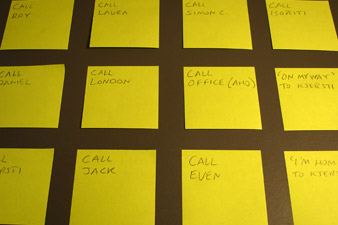
An early Touch-project experiment from December 2005. A grid of RFID tags stuck under the desk, mirrored by a grid of post-it notes on the surface, a phone-book, to-do list and temporary diary in one. Touching the phone to each post-it calls a contact, sends a pre-defined SMS or opens a URL.
-
Nokia 3220 with NFC
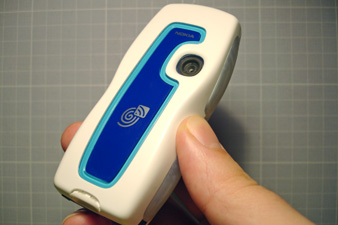
A prototype Nokia 3220 NFC shell has been on loan from Matt Jones at Nokia for a few weeks. Touch it to a tag, the phone vibrates sharply, a light flashes, and something happens, a phone call, a web page, an SMS. It’s the second Nokia phone with an RFID reader-writer, and it is solid enough to build with.
-
Graphic language for touch
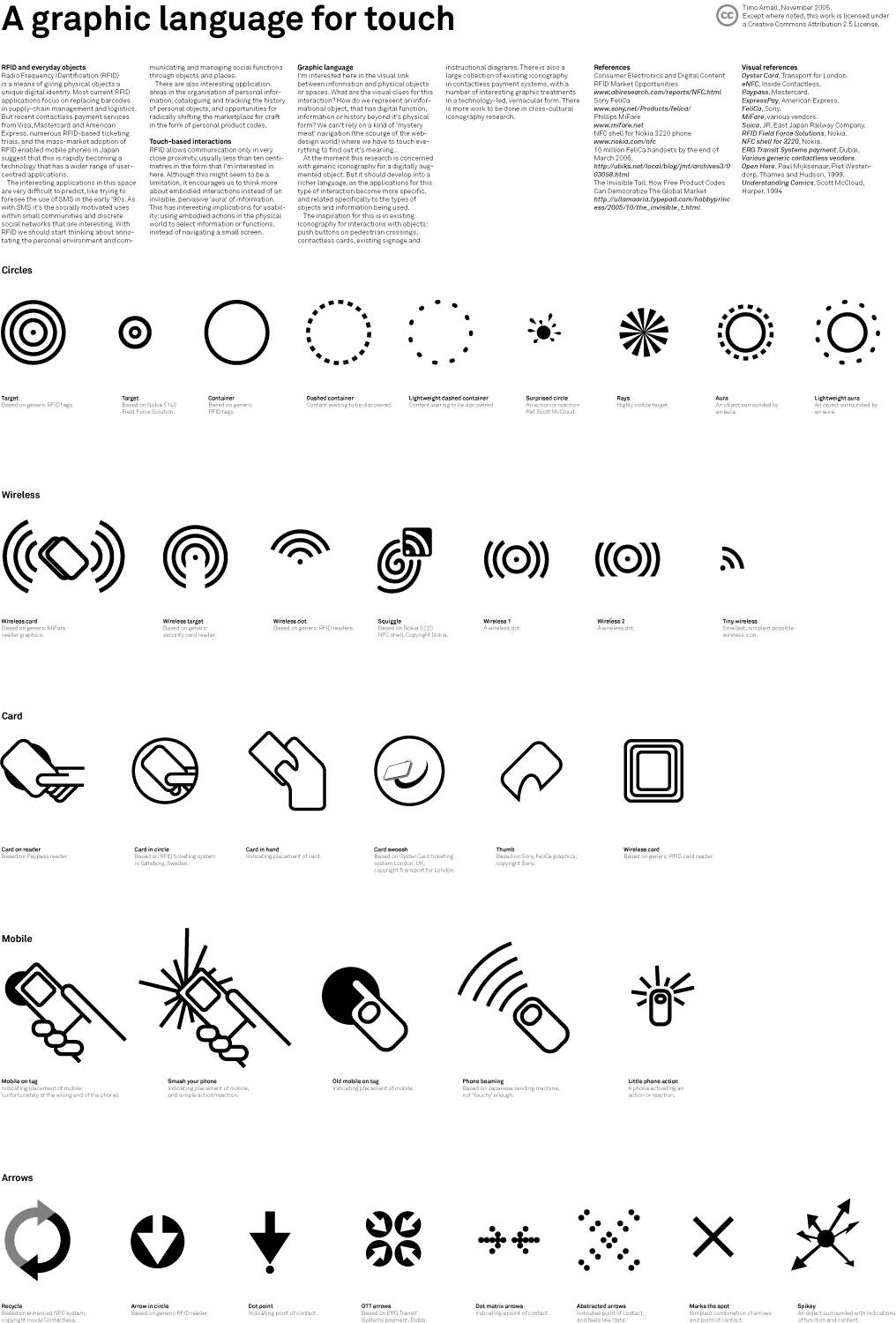
How do we mark up the physical world so people know what’s touchable, and what happens when they touch it? A set of icons I sketched to find out, presented at Design Engaged in Berlin in November 2005.
-
Design Engaged 2005
Three days of conversation, urban exploration and brainstorming in Berlin, November 2005, the second Design Engaged. Adam Greenfield opened on energy decline and the coming implications for design, Anne Galloway on the parliament of things, Joshua Kaufman on the politics of artefacts, Fabio Sergio on whether interaction design has any material at all. Design Engaged 2005, organised by Andrew Otwell for a second year. Raw notes from three days of sessions, preserved as written at the time. Speakers included Adam Greenfield, Matt Ward, Joshua Kaufman, Anne Galloway, Michelle Chang, Thomas Vander Wal, Louise Klinker, Malcolm McCullough, Fabio Sergio, Stefan Smagula, Chris Heathcote, Jyri Engeström and Ulla-Maaria Mutanen, Matt Webb, Nurri Kim, Jack Schulze, Régine Debatty, Liz Goodman, Eric Rodenbeck with Michal Migurski (Stamen), Molly Wright Steenson, John Poisson and Ben Cerveny. Restorative feeling of getting together The architecture of participation Experience design is participation design Ethical and social implications of ubicomp Has been reading far afield: Out of Gas , Dark Age Ahead , Collapse Growth and decline Models of growth: 1. Health of economy is based on growth 2. Continuous growth: technological singularity, going off the charts 3.
-
Embodied interaction in music
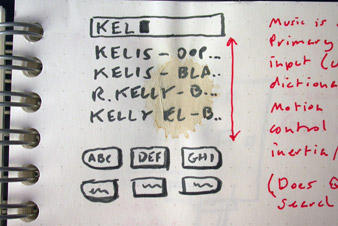
A set of sketches from Easter 2005 on navigating music on portable devices, written after switching from a 40GB iPod to the iPod Shuffle. The clickwheel doesn’t cut it on huge alphabetical lists. The sketches try predictive text input, squeeze-and-shake movement, audio scrubbing and gestures like covering an ear to switch tracks.
-
Tangible and social interaction
On a Nintendo DS in a café, two people are sending each other stick-figure drawings over PictoChat. On a TV in someone’s living room, four people are singing along to Singstar and making each other worse at it. At a bus stop in Berkeley, a phone is quietly logging which other phones it’s been near over the course of a day, a map of familiar strangers. Two lectures given at AHO in Oslo in January 2005, arguing that tangible and social interaction are the next chapter after the desktop. The PDF of the full presentation is here (1.9MB). Posted partly in response to Matt Jones and Chris Heathcote ‘s ETech presentation ( notes , link restored from Wayback). (Based on Dourish, see reading recommendations below.) Each successive development in computer history has made greater use of human skills: Electrical : required a thorough understanding of electrical design Symbolic : required a thorough understanding of the manipulation of abstract languages Textual : text dialogue with the computer, which set the standards of interaction we still live with today Graphic : graphical dialogue with the computer, using our spatial skills, pattern recognition, and motion memory with a mouse and keyboard
-
Sound objects
A box sits on the desk, with no markings on its surface. Touch it with a finger and the box makes a sound, impact, friction, deformation, depending on where you touch. There are soft buttons on the surface, but you can’t see them. You hear them. Notes from Mikael Fernström’s lecture at AHO in February 2005. Fernström runs the Interaction Design Centre at the University of Limerick, where the Soundobject project is working on sound in ubiquitous computing, a relatively unexplored area of interaction design. The aim of the Soundobject research is to liberate interaction design from visual dominance, to free up the eyes, and to do what small displays don’t do well. Sound is currently under-utilised in interaction design Vision is overloaded and our auditory senses are seldom engaged In the world we are used to hearing a lot Adding sound to existing, optimised visual interfaces does not add much to usability Sound is good at attracting attention, which is why alarms and notification systems work. We talked about ‘caller groups’ on mobile phones, assigning different ringtones to people in an address book, and how effectively that changes our relationship with our phones.
-
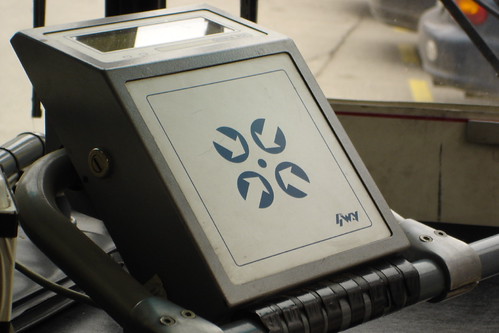
Photos of touch-based interfaces
A February 2005 note that became the start of a longer-running photographic project. In the way Victor Lombardi was collecting images of cardreaders, I was starting to collect images of touch-based interfaces like the Oyster card and other ‘touchable’ interfaces on public transport.
-
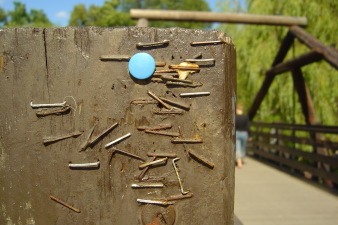
Spatial memory at Design Engaged 2004
Presentation notes from Design Engaged 2004 in Amsterdam. Two related strands: the Time that land forgot project with Even Westvang (five months, 8000 photos, visualised by date and time of day), and the research on marking in urban public space.
-
Design Engaged 2004
Twenty-odd designers, researchers and writers sat around a long table in Amsterdam over a weekend in November 2004, taking turns to present. These are my notes, session-by-session, as written at the time. Design Engaged 2004 was an invitation-only gathering organised by Andrew Otwell. A small, intense weekend of conversation that turned out to be one of the generative moments of the design-web at that period. The FAQ has the full list of attendees. There are also lots of photos on Flickr . The growth of the soil How do we comprehend complexity How do we build structures around complex information Accreting meta-data: GPS data, descriptive information Break down of material as it hits the soil Soup, tags, condensed and distilled meta objects Sorting mechanisms, affinity browsers, related, filtering, emergent relationships, interrelationships How do we conceive a metaphor for building these processes? A structure that is meaningful for the users. Application design: movement through states of application to tending a flow of processes Tending to meta-data is a growth process DLA: diffusion-limited aggregation, a natural process model The relationships between metadata can be visualised as this.
-
Physical computing workshop
Notes from the ‘Making Sense’ physical computing workshop at Atelier Nord in Oslo, September 2004, organised by Erich Berger with Helen Evans and Heiko Hansen of HeHe. The intention was to avoid the screen entirely, to concentrate on simple interactions between sensors and outputs. But here we are, staring at PBasic and JAL while making lots of LEDs blink.
-
Social filtering for online forums
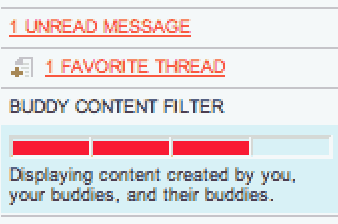
Yayhooray relaunched in June 2004 with a new version that uses social filtering to raise signal-to-noise. As far as I know, this is the first forum to use the buddy list as content filter. A short history of online-forum filtering approaches, and notes on what the new Yayhooray does.
-
Outside In
Outside In was a two-day forum at Röda Sten in Gothenburg on 14–15 June 2004, about new voices, media and practices in the design and use of public space. The venue is extraordinary: below a suspension bridge, surrounded by huge concrete creations. Really windy outside, calm inside the lecture space. These are my notes from the talks, written on the day. Occasional asides in italics are things I’ve added looking back. I’ve left the note form mostly as-is. (I missed the first workshop of the day.) Putting memories in spaces. Spaces aren’t the same after having been disrupted. After ‘Reclaim the Streets’ or a Circle Line party you can’t see the space in the same way. Distinction between public and private. What is it? Public space doesn’t exist anymore. Ken Livingstone’s new City Hall is half-private, half-public, private investment was involved in the building, so protests cannot happen outside. Do we need institutions in order to do events? Is that the only way to do them legally? What’s stopping people from doing these things is not necessarily capitalism but the fear of looking like a pillock. Self-regulation is a big factor. Can spark things to let down inhibitions or shackles. Example of the scooter, became a kids’ toy and then it wasn’t cool anymore.
-
Mobile social software applications
A list of mobile social software applications from 2004: Jabberwocky tracking familiar strangers, Fluidtime routing public transport in Turin, Dodgeball pinging your friends when they’re within ten blocks of you, Plazes tagging your location for the public, Mamjam chatting with others at the same venue by SMS. The first wave of location-aware social services, before smartphones. A growing list I compiled in June 2004 during early PhD research into mobile and locative systems. Descriptions below are taken from each project’s own site. Most of the projects are long gone; the list is preserved as a snapshot of what mobile social software looked like before the iPhone. Companion to the spatial annotation projects list . This research project explores our often ignored yet real relationships with Familiar Strangers. We describe several experiments and studies that lead to a design for a personal, body-worn, wireless device that extends the Familiar Stranger relationship while respecting the delicate, yet important, constraints of our feelings and relationships with strangers in pubic places. A visualization tool based on Mobster that enables users to explore their social encounters in new ways.
-

Spatial annotation projects
A reference list I compiled in June 2004 during early PhD research into locative media and spatial annotation. It includes Murmure in Vancouver’s Chinatown, Yellow Arrow stickers, Grafedia’s hyperlinked handwritten text, Urban Tapestries and dozens of others. The list is preserved as a snapshot of a field at a particular moment.
-

Public markup
Early PhD research into the marking of public space: the physical annotation of the city through stickering, graffiti and billboards. It looks for patterns in visibility, techniques, process, location, content and audience, and argues that the new short-range digital technologies, especially RFID, should be designed the same way. Not invisible.
-
Creative Crossings workshop
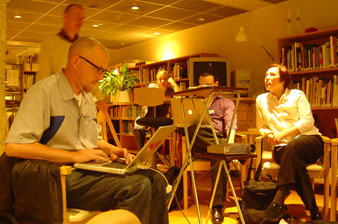
A triangular research network, practitioners from Britain, Canada and Finland, gathered in London to work on participatory and creative applications for mobile, locative and cross-platform media. Organised by m-cult, the Banff Centre and Arts Council England in April 2004.
-
Urban GPS experience
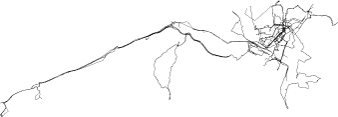
Three months of trying to record a clean dataset of GPS tracks to geo-locate my photography, in Oslo and London. Notes on what the Garmin GPS Map 60c does and doesn’t do in dense European cities, from the pavement and from public transport.
-
Interaction design books
This is one of a series of reading lists I put together between 2002 and 2004 when I was starting out in interaction and experience design, building out a personal canon from books I was buying, borrowing from libraries, or lending to students. The lists are grouped by topic. This is the interaction design shelf itself, and the one where I’ve annotated most of the entries in the original post. Jef Raskin’s The Humane Interface is the one absolutely essential book on this shelf; read it first, and read it more than once. Alan Cooper’s The Inmates Are Running the Asylum is the polemical companion. Lucy Suchman’s Plans and Situated Actions is the theoretical counterpoint, an anthropologist’s argument that interaction is situated in context, not specified in plans. Bergman’s Information Appliances and Beyond is the best case-study collection I know. The Amazon links below are what I had at the time, most will be dead now, but the ISBNs will find you a copy. Pink = highly recommended! Eric Bergman ed. One of the best interaction design books to date. With case-studies on various design problems from Palm OS usability to Nokia contextual design issues. Just enough detail and anecdotes to get a good sense of design process. amazon.co.uk / amazon.com
-
Adaptive design books
This is one of a series of reading lists I put together between 2002 and 2004 when I was starting out in interaction and experience design, building out a personal canon from books I was buying, borrowing from libraries, or lending to students. The lists are grouped by topic. This one is on adaptive design: emergence, pattern languages, the design of things that learn or evolve, and the classics on how cities and communities organise themselves. Christopher Alexander is the spine of this shelf, from Notes on the Synthesis of Form through A Pattern Language to The Nature of Order. Stewart Brand’s How Buildings Learn is the architectural companion. Jane Jacobs’s Death and Life of Great American Cities is the urban-planning foundation. Steven Johnson’s Emergence and Mitchel Resnick’s Turtles, Termites, and Traffic Jams are the approachable modern introductions to complex adaptive systems. Rheingold’s Smart Mobs is the early-2000s prediction of networked collective behaviour that mostly came true. The Amazon links below are what I had at the time, most will be dead now, but the ISBNs will find you a copy. Christopher Alexander. amazon.co.uk / amazon.com Christopher Alexander. amazon.com
-
Design for television
Eighteen points as a minimum type size, if you’re coming from a web background, equates to about 18 pixels. On some interactive television projects I’ve pushed it down to 16, but cautiously, because the production path to air usually punishes small type: DV tape, old composite links, online-edits with high compression. Leave type as large as the design will bear. Notes written in response to David Earls at Typographer.org, who had covered the basics of designing for television and prompted me to add a few things specific to interactive television, which I’d been working on at the time. In some cases (white text on a red background, for instance) a very subtle black drop-shadow will stop colour bleed and crawling effects. Even if you dislike drop-shadows, a subtle one will look flat and lovely on a broadcast monitor. Safe areas need to be taken with a pinch of salt. The default safe areas in most editing and compositing software date from before the widespread use of widescreen sets. Try extending the safe area for non-essential text in interactive projects, and consult broadcaster guidelines for their widescreen policies: many channels now broadcast in 14:9 to terrestrial boxes, with options for satellite and cable viewers.
-
Design management books
This is one of a series of reading lists I put together between 2002 and 2004 when I was starting out in interaction and experience design, building out a personal canon from books I was buying, borrowing from libraries, or lending to students. The lists are grouped by topic. This one is the shortest on the shelf and the most practical, the books on managing design projects, gathering requirements and running workflows. The Robertsons’ Mastering the Requirements Process is the standard reference on requirements gathering. Karl Wiegers’s Software Requirements is the software-engineering equivalent. Goto & Cotler’s Web Redesign is of its moment but it was the manual every web-design studio had on a shelf in 2003. The Amazon links below are what I had at the time, most will be dead now, but the ISBNs will find you a copy. Suzanne Robertson, James Robertson. amazon.co.uk / amazon.com Karl E. Wiegers. amazon.co.uk / amazon.com Jessica Burdman. amazon.co.uk / amazon.com Kelly Goto, Emily Cotler. amazon.co.uk / amazon.com Steve McConnell. amazon.co.uk / amazon.com
-
Usability books
This is one of a series of reading lists I put together between 2002 and 2004 when I was starting out in interaction and experience design, building out a personal canon from books I was buying, borrowing from libraries, or lending to students. The lists are grouped by topic. This one is on usability, the discipline that gave interaction design its empirical grounding. Don Norman’s The Design of Everyday Things is the foundational book, and still the one to read first. Steve Krug’s Don’t Make Me Think is the approachable practitioner’s companion. Beyer & Holtzblatt’s Contextual Design is the canonical research-methods book, the one that taught a generation of designers how to watch users in their actual contexts. Nielsen is the dominant figure of the era, for better and worse; both his books are worth knowing even where you disagree. The Amazon links below are what I had at the time, most will be dead now, but the ISBNs will find you a copy. Donald Norman. amazon.co.uk / amazon.com Donald Norman. amazon.co.uk / amazon.com Douglas K. Van Duyne, James Landay, Jason I. Hong. amazon.co.uk / amazon.com John Cato. amazon.co.uk / amazon.com Hugh Beyer, Karen Holtzblatt. amazon.co.uk / amazon.com
-
Game design books
This is one of a series of reading lists I put together between 2002 and 2004 when I was starting out in interaction and experience design, building out a personal canon from books I was buying, borrowing from libraries, or lending to students. The lists are grouped by topic. This one is on game design, a discipline with a lot to teach interaction designers about engagement, feedback and the design of systems people come back to. Salen & Zimmerman’s Rules of Play is the canonical theoretical text; it did for game design what Bordwell & Thompson did for film. Steven Poole’s Trigger Happy is a cultural rather than technical take, and one of the better-written books on games. Lucien King’s Game On was the Barbican’s 2002 exhibition catalogue, still a useful visual and historical overview. The rest are practical manuals from the pre-indie era of game development. The Amazon links below are what I had at the time, most will be dead now, but the ISBNs will find you a copy. Katie Salen, Eric Zimmerman. amazon.co.uk / amazon.com Bob Bates. amazon.co.uk / amazon.com Andrew Rollings, Ernest Adams. amazon.co.uk / amazon.com Andrew Rollings, Dave Morris. amazon.co.uk / amazon.com Lucien King. amazon.co.uk / amazon.com
-
Technical books
This is one of a series of reading lists I put together between 2002 and 2004 when I was starting out in interaction and experience design, building out a personal canon from books I was buying, borrowing from libraries, or lending to students. The lists are grouped by topic. This one is the shortest, and the most time-stamped: the technical books I was reading when web standards, CSS and accessibility were still being argued over. Much of this has since become second nature or been superseded, but at the time these were the books shaping the craft. Zeldman’s Designing with Web Standards is the generational text of that moment, the book that made the case for separating structure from presentation and won the argument. Eric Meyer on CSS and Håkon Wium Lie’s book on CSS1 are the practical and theoretical companions. Joe Clark’s Building Accessible Websites is the conscience of the shelf. The Amazon links below are what I had at the time, most will be dead now, but the ISBNs will find you a copy. Jeffrey Zeldman. amazon.co.uk / amazon.com Jeffrey Zeldman. A fantastic how-to book for designers looking to get involved in web publishing and design. Takes the reader through writing, usability, architecture and technical tips. amazon.co.uk / amazon.com
-
Interaction and narrative workshop
Notes from a lecture given at Channel 4 in London in February 2002, as part of the Mesh Scheme for digital animation filmmakers. The lecture is aimed at designers and filmmakers thinking about how to make narratives that involve user or audience interaction. Ideologies, examples, processes and the practicalities of stories that aren’t linear. Full notes from the lecture are here .
-
Mobile interaction design case study
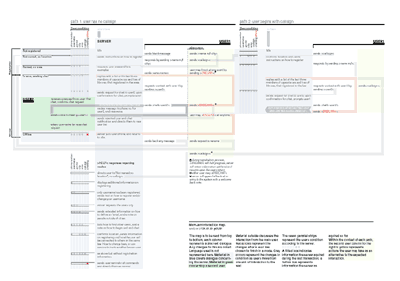
A 2001 case study of consultancy work for Pollen Mobile, written up as it happened. Jack Schulze, Adi Nachman and I designed the interaction architecture for Mamjam, a location-based social entertainment service built on SMS, letting people in the same venue chat with each other by text.
-
Honeysphere collaborative storytelling platform
A 1999 student project at Central Saint Martins, London, by a team of six including me and Jack Schulze . Interactive television, in 1999, meant set-top boxes with return channels, BSkyB’s OpenTV platform, and WebTV. The project won the London Institute Award for Innovation. We presented our findings to the public at the Berlin Film Festival in February 2000. A platform for collaborative storytelling on interactive television, audience members contributing to an unfolding narrative through a shared interface, rather than passively watching a broadcast. A small team at Central Saint Martins researched the state of the field: existing web-based projects in community, gaming, multi-user space, and interactive narrative. The output was a research archive and a set of design patterns for collaborative television software.