Augmented reality experiments
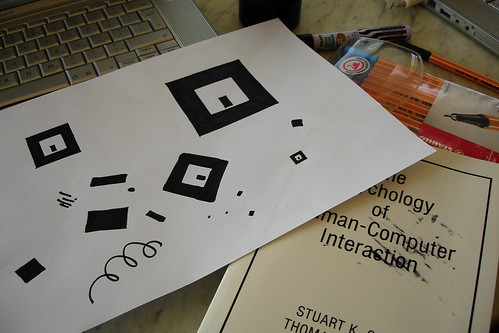
The goggle/glasses/helmet variety of AR is the worst of VR with extra problems: slow, inaccurate, cumbersome, headache-inducing. The user wears something in front of their eyes that superimposes 3D objects on the physical world. AR works when it’s just a screen and a video feed: the same space represented twice, once in front of you, once on screen with overlaid objects. On a mobile phone the screen would act as a magic lens to secret things.
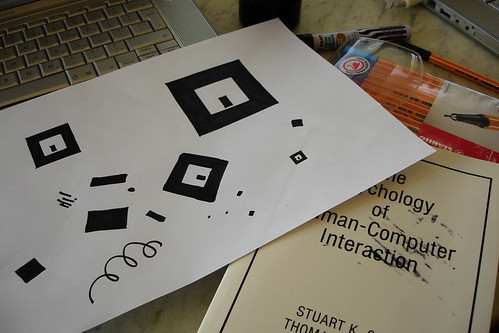
On that afternoon we didn’t have a printer handy for making the AR marks, so we took to drafting them by hand, stencilling them off the screen with a pencil and inking them in. The hand process opened up connections between craft and digital information.
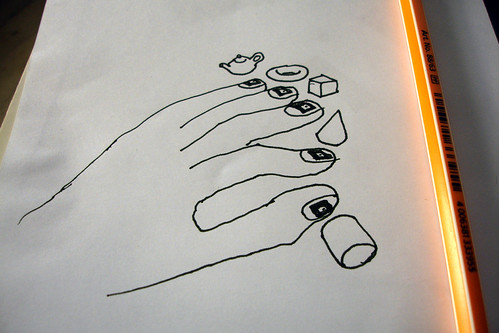
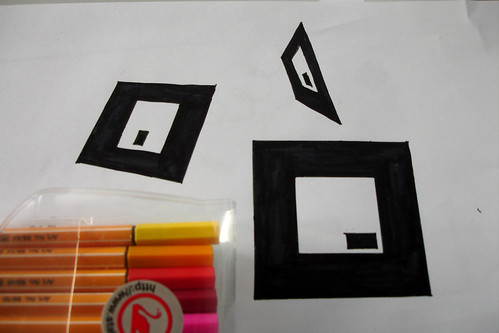
We sketched out printing the markers on clothes, painting them on nails, glazing them into ceramics. We confused ARtoolkit by drawing markers in perspective, and tried to get recursive objects with screen-based markers and video feedback.
An entire research programme is looking at this. Variable Environment with ECAL and EPFL, blogging the entire exploratory (they call it ‘sketch’) phase and curating the results online. The work is multi-disciplinary and involves architects, visual designers, computer scientists, interaction designers, etc. Check out the simple AR ready products, sample applications and mixed reality tests with various patterns.
This is part of a shift in the research community towards publishing ongoing exploratory work online, championed by Nicolas Nova and Anne Galloway.