Ubicomp
16 posts tagged.
-
No to NoUI
‘The best design is invisible’ is the interaction design phrase of the moment. This is a critique of the NoUI movement: we must abandon invisibility as a goal for interfaces. It’s misleading, unhelpful, dishonest.
-
Connecting the digital world with print
A rare piece of writing from Durrell Bishop : Read the whole thing: Connecting the digital world with print .
-
A phone to save us from our screens?
Microsoft has two new ads, anticipating their upcoming Windows Phone 7 launch. The first is an almost post-apocalyptic vision of humanity stuck with their heads in their mobile devices: Here’s David Webster , chief strategy officer in Microsoft’s central marketing group, explaining their anti-screen strategy: The problem of glowing rectangles is a subject close to my heart , and Matt Jones has been bothered by the increase in mobile glowing attention-wells . I think Microsoft & Crispin Porter + Bogusky’s advertising strategy stands out in a world full of slick floaty media . The only problem is that without any strategy towards tangible interaction, I’m not sure the ‘tiles’ interaction concept is strong enough to actually take people’s attention out of the glass.
-
CCD and computational photography
A few links on imaging and computation: from CCD by Joe Gregorio . Via BERG. from Computational Photography, American Scientist from What Photography Will Look Like By 2060
-
Augmentia
Anselm Hook , one of the founding thinkers of the geo-web, co-organiser of the first ARDevCamp at the Hacker Dojo in Mountain View late last year, lays out the emerging issues with Augmented Reality. He relates it to a whole host of known and unknown problems around ubiquitous computing, semantic publishing and data platforms. A few passages worth holding on to:
-
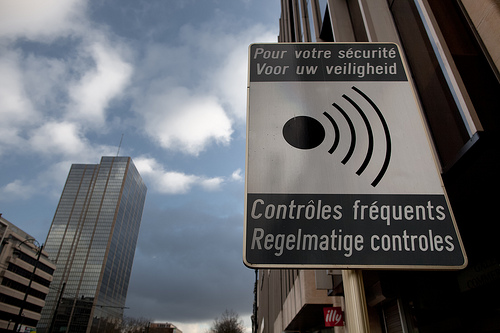
Pour votre sécurité
A single photograph of ‘Pour votre sécurité’ signage, dated 17 January 2010.
-
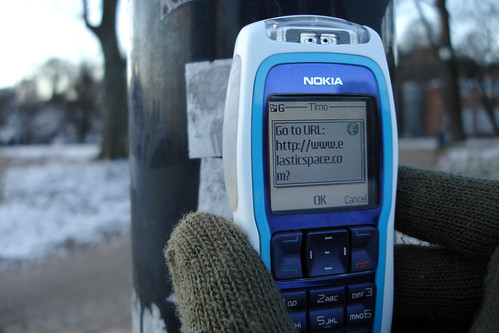
Touch
An AHO research project on what designers should do with NFC. Touch a phone to a tag, the tag answers, something happens. A phone call, an SMS, a URL. Funded by the Research Council of Norway, running since March 2006 with a project weblog at nearfield.org.
-
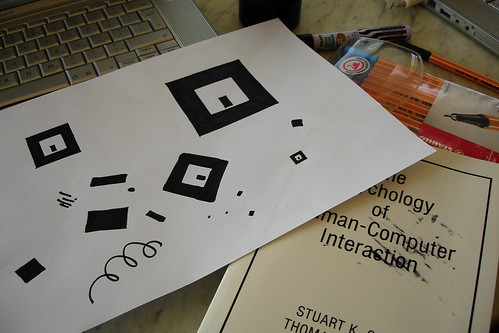
Augmented reality experiments
An afternoon with Even Westvang and ARtoolkit, the open-source library for augmented reality markers. No printer handy, so we drafted the markers by hand, stencilling them off the screen with a pencil and inking them in, and confused ARtoolkit by drawing them in perspective.
-
The address book desk
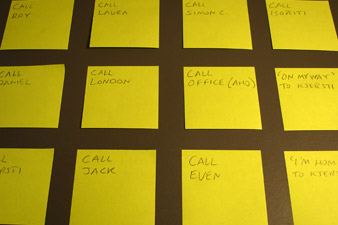
An early Touch-project experiment from December 2005. A grid of RFID tags stuck under the desk, mirrored by a grid of post-it notes on the surface, a phone-book, to-do list and temporary diary in one. Touching the phone to each post-it calls a contact, sends a pre-defined SMS or opens a URL.
-
Nokia 3220 with NFC
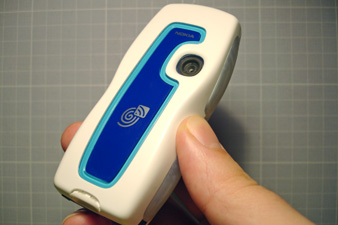
A prototype Nokia 3220 NFC shell has been on loan from Matt Jones at Nokia for a few weeks. Touch it to a tag, the phone vibrates sharply, a light flashes, and something happens, a phone call, a web page, an SMS. It’s the second Nokia phone with an RFID reader-writer, and it is solid enough to build with.
-
Graphic language for touch
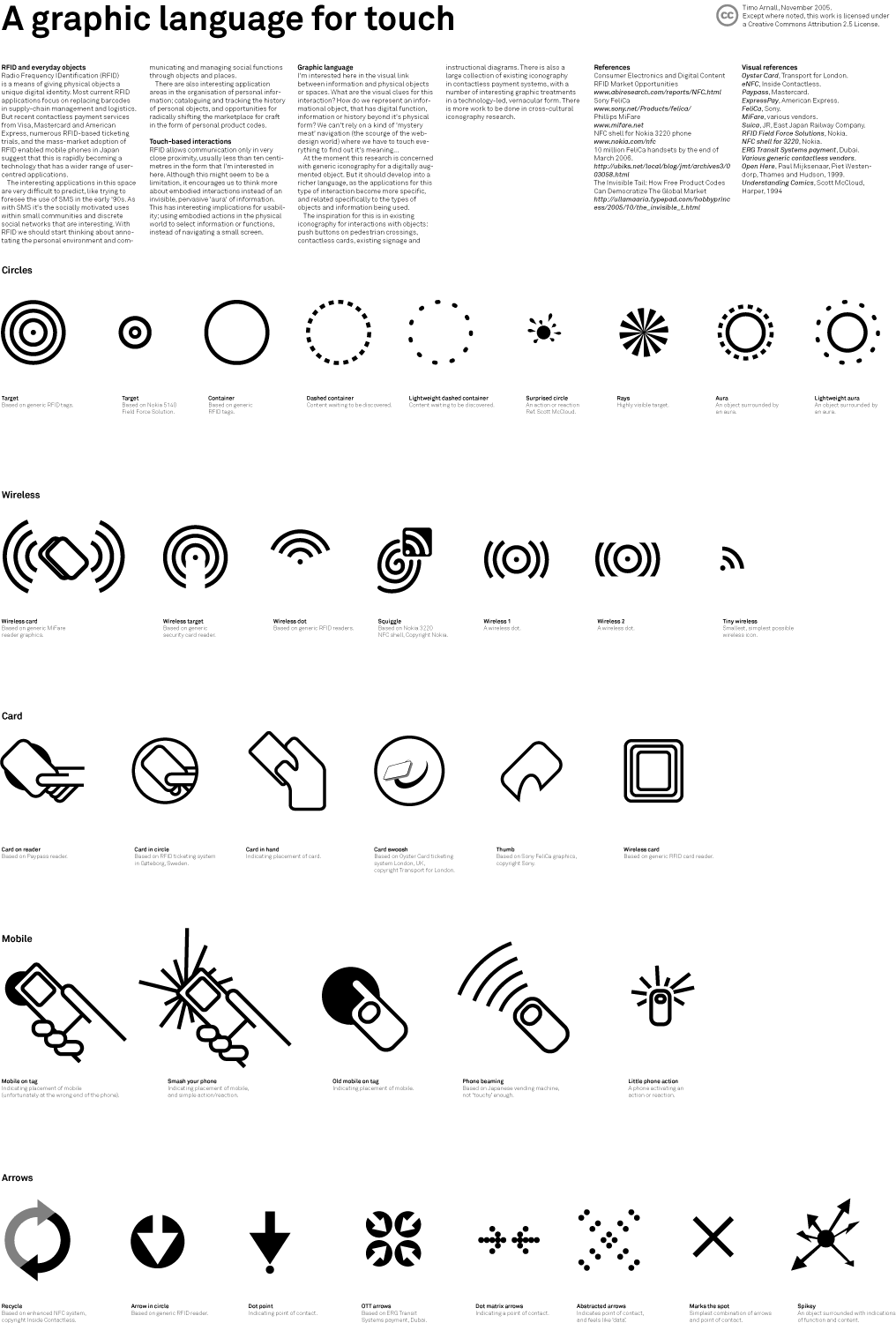
How do we mark up the physical world so people know what’s touchable, and what happens when they touch it? A set of icons I sketched to find out, presented at Design Engaged in Berlin in November 2005.
-
Design Engaged 2005
Three days of conversation, urban exploration and brainstorming in Berlin, November 2005, the second Design Engaged. Adam Greenfield opened on energy decline and the coming implications for design, Anne Galloway on the parliament of things, Joshua Kaufman on the politics of artefacts, Fabio Sergio on whether interaction design has any material at all. Design Engaged 2005, organised by Andrew Otwell for a second year. Raw notes from three days of sessions, preserved as written at the time. Speakers included Adam Greenfield, Matt Ward, Joshua Kaufman, Anne Galloway, Michelle Chang, Thomas Vander Wal, Louise Klinker, Malcolm McCullough, Fabio Sergio, Stefan Smagula, Chris Heathcote, Jyri Engeström and Ulla-Maaria Mutanen, Matt Webb, Nurri Kim, Jack Schulze, Régine Debatty, Liz Goodman, Eric Rodenbeck with Michal Migurski (Stamen), Molly Wright Steenson, John Poisson and Ben Cerveny. Restorative feeling of getting together The architecture of participation Experience design is participation design Ethical and social implications of ubicomp Has been reading far afield: Out of Gas , Dark Age Ahead , Collapse Growth and decline Models of growth: 1. Health of economy is based on growth 2. Continuous growth: technological singularity, going off the charts 3.
-
Tangible and social interaction
On a Nintendo DS in a café, two people are sending each other stick-figure drawings over PictoChat. On a TV in someone’s living room, four people are singing along to Singstar and making each other worse at it. At a bus stop in Berkeley, a phone is quietly logging which other phones it’s been near over the course of a day, a map of familiar strangers. Two lectures given at AHO in Oslo in January 2005, arguing that tangible and social interaction are the next chapter after the desktop. The PDF of the full presentation is here (1.9MB). Posted partly in response to Matt Jones and Chris Heathcote ‘s ETech presentation ( notes , link restored from Wayback). (Based on Dourish, see reading recommendations below.) Each successive development in computer history has made greater use of human skills: Electrical : required a thorough understanding of electrical design Symbolic : required a thorough understanding of the manipulation of abstract languages Textual : text dialogue with the computer, which set the standards of interaction we still live with today Graphic : graphical dialogue with the computer, using our spatial skills, pattern recognition, and motion memory with a mouse and keyboard
-
Sound objects
A box sits on the desk, with no markings on its surface. Touch it with a finger and the box makes a sound, impact, friction, deformation, depending on where you touch. There are soft buttons on the surface, but you can’t see them. You hear them. Notes from Mikael Fernström’s lecture at AHO in February 2005. Fernström runs the Interaction Design Centre at the University of Limerick, where the Soundobject project is working on sound in ubiquitous computing, a relatively unexplored area of interaction design. The aim of the Soundobject research is to liberate interaction design from visual dominance, to free up the eyes, and to do what small displays don’t do well. Sound is currently under-utilised in interaction design Vision is overloaded and our auditory senses are seldom engaged In the world we are used to hearing a lot Adding sound to existing, optimised visual interfaces does not add much to usability Sound is good at attracting attention, which is why alarms and notification systems work. We talked about ‘caller groups’ on mobile phones, assigning different ringtones to people in an address book, and how effectively that changes our relationship with our phones.
-
Photos of touch-based interfaces
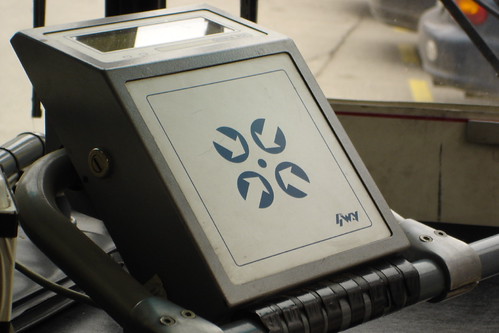
A February 2005 note that became the start of a longer-running photographic project. In the way Victor Lombardi was collecting images of cardreaders, I was starting to collect images of touch-based interfaces like the Oyster card and other ‘touchable’ interfaces on public transport.
-
Spatial memory at Design Engaged 2004
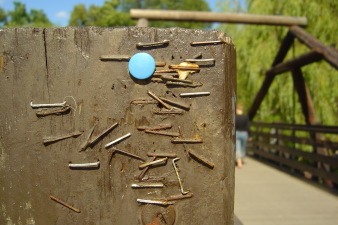
Presentation notes from Design Engaged 2004 in Amsterdam. Two related strands: the Time that land forgot project with Even Westvang (five months, 8000 photos, visualised by date and time of day), and the research on marking in urban public space.