Architecture
3 posts tagged.
-
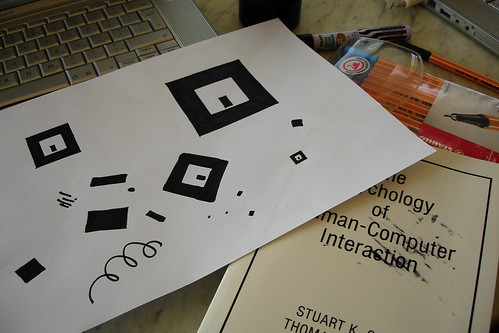
Augmented reality experiments
An afternoon with Even Westvang and ARtoolkit, the open-source library for augmented reality markers. No printer handy, so we drafted the markers by hand, stencilling them off the screen with a pencil and inking them in, and confused ARtoolkit by drawing them in perspective.
-
Outside In
Outside In was a two-day forum at Röda Sten in Gothenburg on 14–15 June 2004, about new voices, media and practices in the design and use of public space. The venue is extraordinary: below a suspension bridge, surrounded by huge concrete creations. Really windy outside, calm inside the lecture space. These are my notes from the talks, written on the day. Occasional asides in italics are things I’ve added looking back. I’ve left the note form mostly as-is. (I missed the first workshop of the day.) Putting memories in spaces. Spaces aren’t the same after having been disrupted. After ‘Reclaim the Streets’ or a Circle Line party you can’t see the space in the same way. Distinction between public and private. What is it? Public space doesn’t exist anymore. Ken Livingstone’s new City Hall is half-private, half-public, private investment was involved in the building, so protests cannot happen outside. Do we need institutions in order to do events? Is that the only way to do them legally? What’s stopping people from doing these things is not necessarily capitalism but the fear of looking like a pillock. Self-regulation is a big factor. Can spark things to let down inhibitions or shackles. Example of the scooter, became a kids’ toy and then it wasn’t cool anymore.
-
Architecture theory books
This is one of a series of reading lists I put together between 2002 and 2004 when I was starting out in interaction and experience design, building out a personal canon from books I was buying, borrowing from libraries, or lending to students. The lists are grouped by topic. Architecture is the parent discipline of a lot of interaction design thinking, and this list is the shelf I was reading on the theory side: space, the city, urbanism, and the politics of the built environment. Calvino’s Invisible Cities is the book I keep giving to people. Bachelard’s Poetics of Space is the phenomenological counterpart, both are worth reading slowly. Bernard Tschumi’s Architecture and Disjunction and Manhattan Transcripts are the most polemical of the theoretical books. William J. Mitchell’s City of Bits and E-topia are the early digital-urbanism texts that most directly speak to interaction designers working on networked spaces. The Amazon links below are what I had at the time, most will be dead now, but the ISBNs will find you a copy. M. Christine Boyer. amazon.co.uk / amazon.com Nick Barley. amazon.co.uk / amazon.com Manuel Gausa. amazon.co.uk / amazon.com Norman Foster. amazon.co.uk / amazon.com