Experience Design
11 posts tagged.
-
Design Engaged 2004
Twenty-odd designers, researchers and writers sat around a long table in Amsterdam over a weekend in November 2004, taking turns to present. These are my notes, session-by-session, as written at the time. Design Engaged 2004 was an invitation-only gathering organised by Andrew Otwell. A small, intense weekend of conversation that turned out to be one of the generative moments of the design-web at that period. The FAQ has the full list of attendees. There are also lots of photos on Flickr . The growth of the soil How do we comprehend complexity How do we build structures around complex information Accreting meta-data: GPS data, descriptive information Break down of material as it hits the soil Soup, tags, condensed and distilled meta objects Sorting mechanisms, affinity browsers, related, filtering, emergent relationships, interrelationships How do we conceive a metaphor for building these processes? A structure that is meaningful for the users. Application design: movement through states of application to tending a flow of processes Tending to meta-data is a growth process DLA: diffusion-limited aggregation, a natural process model The relationships between metadata can be visualised as this.
-
Time that land forgot
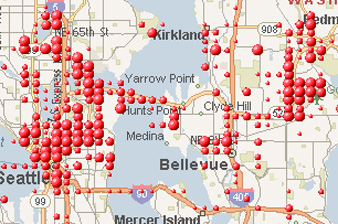
A 2004 project with Even Westvang from the Iceland inside-and-out workshop, a prototype for contextualising photographs by time and geography, designed to shift the balance of representation away from pure location and towards image and time.
-
Outside In
Outside In was a two-day forum at Röda Sten in Gothenburg on 14–15 June 2004, about new voices, media and practices in the design and use of public space. The venue is extraordinary: below a suspension bridge, surrounded by huge concrete creations. Really windy outside, calm inside the lecture space. These are my notes from the talks, written on the day. Occasional asides in italics are things I’ve added looking back. I’ve left the note form mostly as-is. (I missed the first workshop of the day.) Putting memories in spaces. Spaces aren’t the same after having been disrupted. After ‘Reclaim the Streets’ or a Circle Line party you can’t see the space in the same way. Distinction between public and private. What is it? Public space doesn’t exist anymore. Ken Livingstone’s new City Hall is half-private, half-public, private investment was involved in the building, so protests cannot happen outside. Do we need institutions in order to do events? Is that the only way to do them legally? What’s stopping people from doing these things is not necessarily capitalism but the fear of looking like a pillock. Self-regulation is a big factor. Can spark things to let down inhibitions or shackles. Example of the scooter, became a kids’ toy and then it wasn’t cool anymore.
-
Mobile social software applications
A list of mobile social software applications from 2004: Jabberwocky tracking familiar strangers, Fluidtime routing public transport in Turin, Dodgeball pinging your friends when they’re within ten blocks of you, Plazes tagging your location for the public, Mamjam chatting with others at the same venue by SMS. The first wave of location-aware social services, before smartphones. A growing list I compiled in June 2004 during early PhD research into mobile and locative systems. Descriptions below are taken from each project’s own site. Most of the projects are long gone; the list is preserved as a snapshot of what mobile social software looked like before the iPhone. Companion to the spatial annotation projects list . This research project explores our often ignored yet real relationships with Familiar Strangers. We describe several experiments and studies that lead to a design for a personal, body-worn, wireless device that extends the Familiar Stranger relationship while respecting the delicate, yet important, constraints of our feelings and relationships with strangers in pubic places. A visualization tool based on Mobster that enables users to explore their social encounters in new ways.
-

Urban GPS experience
Three months of trying to record a clean dataset of GPS tracks to geo-locate my photography, in Oslo and London. Notes on what the Garmin GPS Map 60c does and doesn’t do in dense European cities, from the pavement and from public transport.
-
Design for television
Eighteen points as a minimum type size, if you’re coming from a web background, equates to about 18 pixels. On some interactive television projects I’ve pushed it down to 16, but cautiously, because the production path to air usually punishes small type: DV tape, old composite links, online-edits with high compression. Leave type as large as the design will bear. Notes written in response to David Earls at Typographer.org, who had covered the basics of designing for television and prompted me to add a few things specific to interactive television, which I’d been working on at the time. In some cases (white text on a red background, for instance) a very subtle black drop-shadow will stop colour bleed and crawling effects. Even if you dislike drop-shadows, a subtle one will look flat and lovely on a broadcast monitor. Safe areas need to be taken with a pinch of salt. The default safe areas in most editing and compositing software date from before the widespread use of widescreen sets. Try extending the safe area for non-essential text in interactive projects, and consult broadcaster guidelines for their widescreen policies: many channels now broadcast in 14:9 to terrestrial boxes, with options for satellite and cable viewers.
-
Game design books
This is one of a series of reading lists I put together between 2002 and 2004 when I was starting out in interaction and experience design, building out a personal canon from books I was buying, borrowing from libraries, or lending to students. The lists are grouped by topic. This one is on game design, a discipline with a lot to teach interaction designers about engagement, feedback and the design of systems people come back to. Salen & Zimmerman’s Rules of Play is the canonical theoretical text; it did for game design what Bordwell & Thompson did for film. Steven Poole’s Trigger Happy is a cultural rather than technical take, and one of the better-written books on games. Lucien King’s Game On was the Barbican’s 2002 exhibition catalogue, still a useful visual and historical overview. The rest are practical manuals from the pre-indie era of game development. The Amazon links below are what I had at the time, most will be dead now, but the ISBNs will find you a copy. Katie Salen, Eric Zimmerman. amazon.co.uk / amazon.com Bob Bates. amazon.co.uk / amazon.com Andrew Rollings, Ernest Adams. amazon.co.uk / amazon.com Andrew Rollings, Dave Morris. amazon.co.uk / amazon.com Lucien King. amazon.co.uk / amazon.com
-
Experience design books
This is one of a series of reading lists I put together between 2002 and 2004 when I was starting out in interaction and experience design, building out a personal canon from books I was buying, borrowing from libraries, or lending to students. The lists are grouped by topic. This one is on experience design itself, the books that were building the vocabulary for the field at the time. Jesse James Garrett’s The Elements of User Experience is still the clearest practitioner’s framework. Dewey’s Art as Experience from the 1930s is the philosophical foundation; the chapter called ‘What is an experience’ is worth reading on its own. Csikszentmihalyi’s Flow is the psychological counterpart. James Cousins’s British Rail Design, out of print, is a fascinating case study of integrated experience design across every touchpoint of a service, from seat-fabric to signage. The Amazon links below are what I had at the time, most will be dead now, but the ISBNs will find you a copy. Jesse James Garrett. This small book succinctly and professionally explains the entire user-experience field. Every page has some insight to offer; from user-centred strategy to visual branding and graphics. For more information see jjg.net . amazon.co.uk / amazon.com
-
Brand and communication books
This is one of a series of reading lists I put together between 2002 and 2004 when I was starting out in interaction and experience design, building out a personal canon from books I was buying, borrowing from libraries, or lending to students. The lists are grouped by topic. This one is on brand and communication: identity systems, the commercial and political arguments around branding, and strategic brand management. Klein’s No Logo is the political counterweight to everything else on this shelf. Wally Olins’s The Guide to Identity is the canonical practitioner’s text on identity systems; he co-wrote the third title here too. Jane Pavitt’s Brand New was the V&A’s Brand New catalogue, a visual overview of what corporate identity looked like at the turn of the millennium. The Amazon links below are what I had at the time, most will be dead now, but the ISBNs will find you a copy. Naomi Klein. amazon.co.uk / amazon.com Wally Olins. amazon.co.uk / amazon.com Cees van Riel, Wally Olins. amazon.co.uk / amazon.com Jane Pavitt ed. amazon.co.uk / amazon.com Jean-Noel Kapferer. amazon.co.uk / amazon.com Hamish Pringle, William Gordon. amazon.co.uk / amazon.com
-
Business and strategy books
This is one of a series of reading lists I put together between 2002 and 2004 when I was starting out in interaction and experience design, building out a personal canon from books I was buying, borrowing from libraries, or lending to students. The lists are grouped by topic. This one is short: the business and strategy books I was reading to understand where design sits in the wider commercial conversation. Christensen’s The Innovator’s Dilemma is the single most useful book here. The Experience Economy by Pine & Gilmore is the strategic framing most relevant to experience design; it made the argument that experience itself is the product. The rest are either IDEO-perspective (Kelley) or of their moment (the Dream Society and Experiential Marketing). The Amazon links below are what I had at the time, most will be dead now, but the ISBNs will find you a copy. Tom Kelley. amazon.co.uk / amazon.com Clayton M. Christensen. amazon.co.uk / amazon.com Rolf Jensen. amazon.co.uk / amazon.com B. Joseph Pine. amazon.co.uk / amazon.com Bernd H. Schmitt. amazon.co.uk / amazon.com
-
The Landscape of Experience
Three days of conference notes from Living Surfaces 2001 in Chicago, November 2001, an AIGA conference on experience design, interactive media and the design practice emerging around them. Written as a trip report for UK colleagues in the days after returning to London. Speakers included Mohan Sawhney, Nick Durrant, Michael Schrage, Tim Parsey of Motorola, Hugh Dubberly, Don Norman, Idit Harel of MamaMedia and Julie Pokorny of Lante, among others. At the time, “experience design” was a new enough term that the conference was partly an exercise in defining it. The notes are preserved as written in November 2001, lightly tidied but otherwise intact. Speakers were reasonably diverse, with no overall design, HCI or usability focus, definitely attempting to be inclusive under the term “experience design”. I have a clearer overview of the state of the US design landscape, and the kind of work that intelligent agencies and individuals are undertaking. There were a number of very sharp individuals presenting. Experience design is a widely accepted term, widely understood as a process, and validated by the client and market reaction. There is a vacuum waiting to be filled after years of new-media mishap and recent financial failure.