Mobility
17 posts tagged.
-
A phone to save us from our screens?
Microsoft has two new ads, anticipating their upcoming Windows Phone 7 launch. The first is an almost post-apocalyptic vision of humanity stuck with their heads in their mobile devices: Here’s David Webster , chief strategy officer in Microsoft’s central marketing group, explaining their anti-screen strategy: The problem of glowing rectangles is a subject close to my heart , and Matt Jones has been bothered by the increase in mobile glowing attention-wells . I think Microsoft & Crispin Porter + Bogusky’s advertising strategy stands out in a world full of slick floaty media . The only problem is that without any strategy towards tangible interaction, I’m not sure the ‘tiles’ interaction concept is strong enough to actually take people’s attention out of the glass.
-
Touch
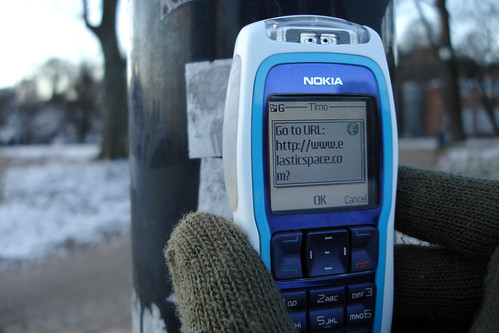
An AHO research project on what designers should do with NFC. Touch a phone to a tag, the tag answers, something happens. A phone call, an SMS, a URL. Funded by the Research Council of Norway, running since March 2006 with a project weblog at nearfield.org.
-
Nokia 3220 with NFC
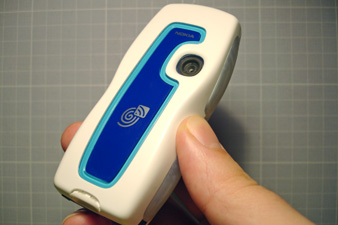
A prototype Nokia 3220 NFC shell has been on loan from Matt Jones at Nokia for a few weeks. Touch it to a tag, the phone vibrates sharply, a light flashes, and something happens, a phone call, a web page, an SMS. It’s the second Nokia phone with an RFID reader-writer, and it is solid enough to build with.
-
Graphic language for touch
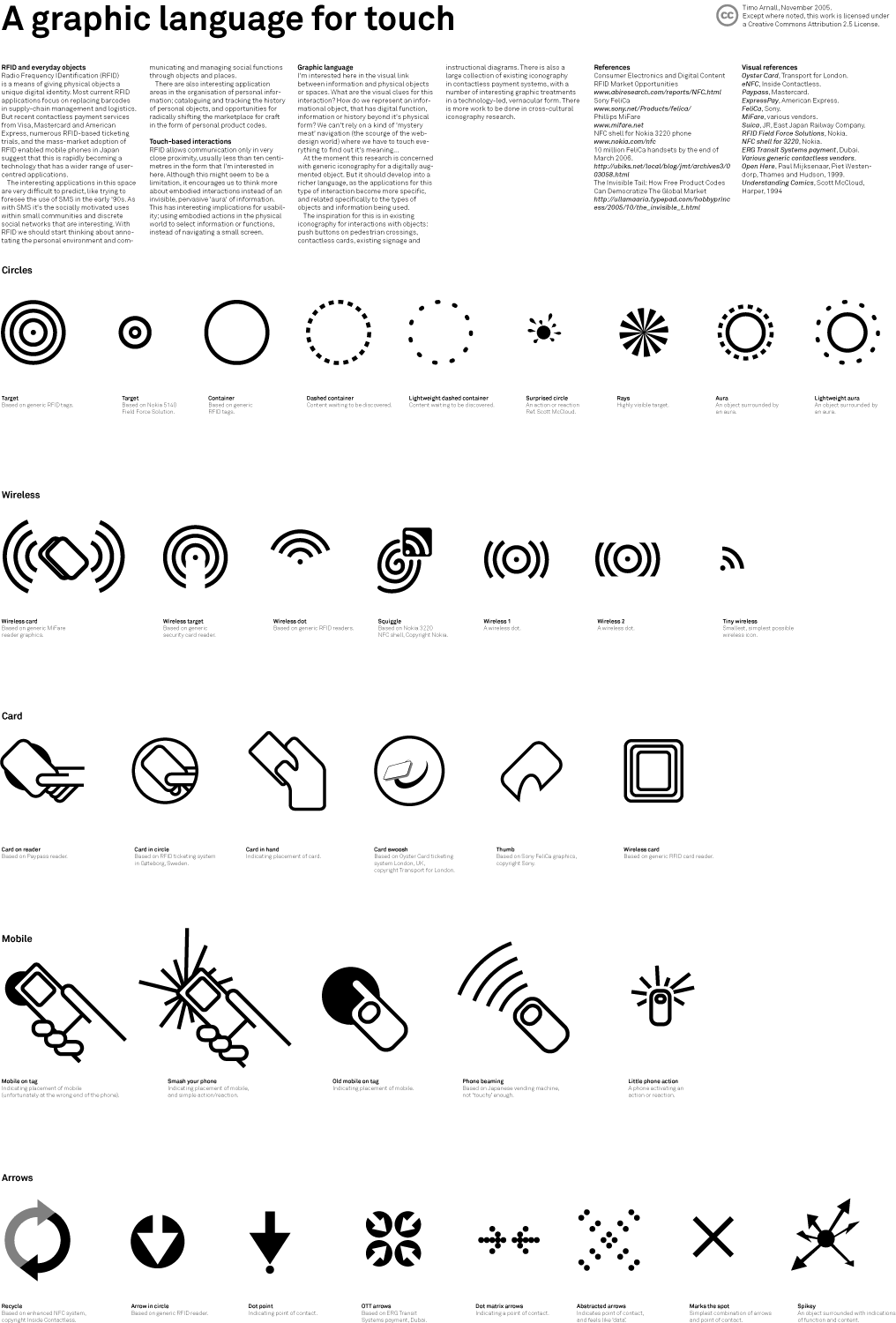
How do we mark up the physical world so people know what’s touchable, and what happens when they touch it? A set of icons I sketched to find out, presented at Design Engaged in Berlin in November 2005.
-
Embodied interaction in music
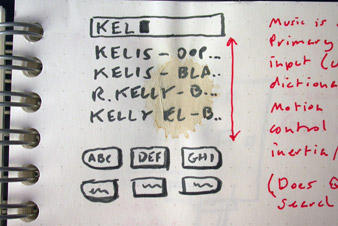
A set of sketches from Easter 2005 on navigating music on portable devices, written after switching from a 40GB iPod to the iPod Shuffle. The clickwheel doesn’t cut it on huge alphabetical lists. The sketches try predictive text input, squeeze-and-shake movement, audio scrubbing and gestures like covering an ear to switch tracks.
-
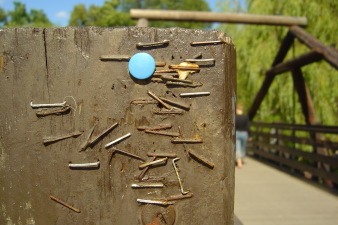
Spatial memory at Design Engaged 2004
Presentation notes from Design Engaged 2004 in Amsterdam. Two related strands: the Time that land forgot project with Even Westvang (five months, 8000 photos, visualised by date and time of day), and the research on marking in urban public space.
-
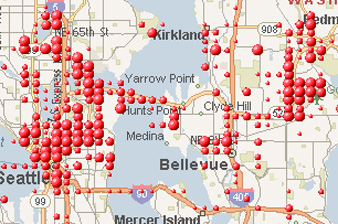
Time that land forgot
A 2004 project with Even Westvang from the Iceland inside-and-out workshop, a prototype for contextualising photographs by time and geography, designed to shift the balance of representation away from pure location and towards image and time.
-
Loop city workshop
Bill Hillier at University College London describes cities as movement economies, the structure of a city is the pattern of people moving through it. The workshop took this as the starting point and spent two days walking that idea across related fields: spatial organisation, relative space, time-space, taxicab geometry, mental mapping, text maps. Notes from the Loop City workshop at the Outside In symposium in Gothenburg, Sweden, June 2004. The workshop was led by Dietmar Offenhuber and Sara Hodges with participants from the symposium, working across geography, architecture, mapping and locative media. Raw notes below. spacesyntax.com Space explorers : children, homeless, vendors, skateboarders Space utilisers : commuters, workers Exocentric : external, connected Egocentric : centred, point of view Large, diverse research field Abler, Adams and Gould: Spatial Organization: The Geographer’s View of the World Expressing thematic data through spatial differentiation Political maps based on size of army Map of USA based on Elvis concerts Irina Vasiliev: Design Issues for Mapping Time Time as a way of measuring space (one conclusion: the world is shrinking) Grid systems make diagonal m…
-
Mobile outskirts workshop
A bus full of GPS receivers, cameras and impromptu artworks drove fifteen hours from Trondheim up to the islands of Lofoten. The workshop wiki and media archive are being kept updated via fairly limited wireless coverage. A short dispatch from the Mobile Outskirts workshop in Lofoten, June 2004, part of the Trans-cultural Mapping workshop series . A painless and creative bus drive up the Norwegian coast.
-
Outside In
Outside In was a two-day forum at Röda Sten in Gothenburg on 14–15 June 2004, about new voices, media and practices in the design and use of public space. The venue is extraordinary: below a suspension bridge, surrounded by huge concrete creations. Really windy outside, calm inside the lecture space. These are my notes from the talks, written on the day. Occasional asides in italics are things I’ve added looking back. I’ve left the note form mostly as-is. (I missed the first workshop of the day.) Putting memories in spaces. Spaces aren’t the same after having been disrupted. After ‘Reclaim the Streets’ or a Circle Line party you can’t see the space in the same way. Distinction between public and private. What is it? Public space doesn’t exist anymore. Ken Livingstone’s new City Hall is half-private, half-public, private investment was involved in the building, so protests cannot happen outside. Do we need institutions in order to do events? Is that the only way to do them legally? What’s stopping people from doing these things is not necessarily capitalism but the fear of looking like a pillock. Self-regulation is a big factor. Can spark things to let down inhibitions or shackles. Example of the scooter, became a kids’ toy and then it wasn’t cool anymore.
-
Mobile social software applications
A list of mobile social software applications from 2004: Jabberwocky tracking familiar strangers, Fluidtime routing public transport in Turin, Dodgeball pinging your friends when they’re within ten blocks of you, Plazes tagging your location for the public, Mamjam chatting with others at the same venue by SMS. The first wave of location-aware social services, before smartphones. A growing list I compiled in June 2004 during early PhD research into mobile and locative systems. Descriptions below are taken from each project’s own site. Most of the projects are long gone; the list is preserved as a snapshot of what mobile social software looked like before the iPhone. Companion to the spatial annotation projects list . This research project explores our often ignored yet real relationships with Familiar Strangers. We describe several experiments and studies that lead to a design for a personal, body-worn, wireless device that extends the Familiar Stranger relationship while respecting the delicate, yet important, constraints of our feelings and relationships with strangers in pubic places. A visualization tool based on Mobster that enables users to explore their social encounters in new ways.
-
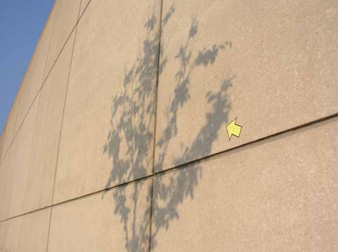
Spatial annotation projects
A reference list I compiled in June 2004 during early PhD research into locative media and spatial annotation. It includes Murmure in Vancouver’s Chinatown, Yellow Arrow stickers, Grafedia’s hyperlinked handwritten text, Urban Tapestries and dozens of others. The list is preserved as a snapshot of a field at a particular moment.
-
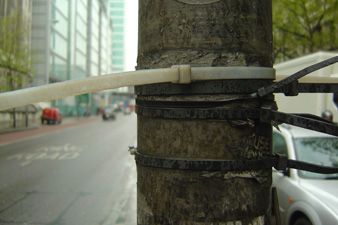
Public markup
Early PhD research into the marking of public space: the physical annotation of the city through stickering, graffiti and billboards. It looks for patterns in visibility, techniques, process, location, content and audience, and argues that the new short-range digital technologies, especially RFID, should be designed the same way. Not invisible.
-
Creative Crossings workshop
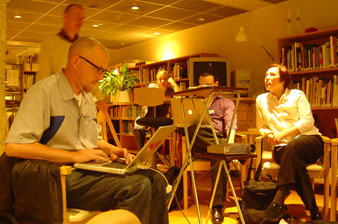
A triangular research network, practitioners from Britain, Canada and Finland, gathered in London to work on participatory and creative applications for mobile, locative and cross-platform media. Organised by m-cult, the Banff Centre and Arts Council England in April 2004.
-
Urban GPS experience
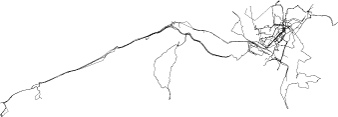
Three months of trying to record a clean dataset of GPS tracks to geo-locate my photography, in Oslo and London. Notes on what the Garmin GPS Map 60c does and doesn’t do in dense European cities, from the pavement and from public transport.
-
Mess TV: SMS and MMS community television
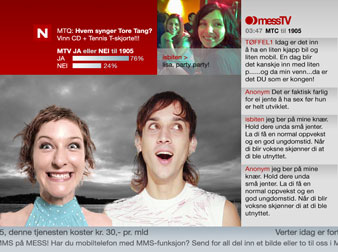
A nightly community TV show on TV Norge, running from 2am to noon the next day, carried largely by SMS and MMS messages submitted from mobile phones. I rebranded the show against the TV Norge visual identity, refined the SMS and MMS interaction scenarios, and advised on linear broadcast and interactive content.
-
Mobile interaction design case study
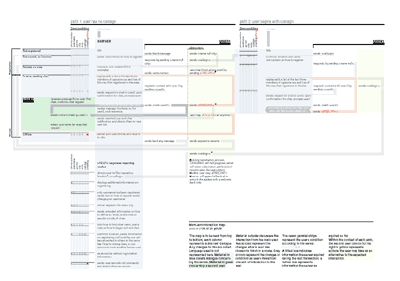
A 2001 case study of consultancy work for Pollen Mobile, written up as it happened. Jack Schulze, Adi Nachman and I designed the interaction architecture for Mamjam, a location-based social entertainment service built on SMS, letting people in the same venue chat with each other by text.