Notcon 04
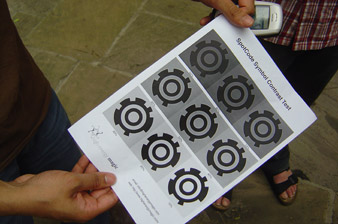
A circular barcode printed on a sticker, small enough to fit on a poster edge. Point a Nokia Series 60 camera phone at it and the phone reads 42 bits of data, enough to trigger a URL, a Bluetooth handshake, a position fix. Spotcodes.
Two things from Notcon 04 in London worth writing up. A May 2004 not-con organised by Yoz Grahame and others, as a cheap and unstructured alternative to the more formal industry events. Notes below.
Barcodes for spatial markup and control
Spotcodes use a very simple circular barcode to mark objects for interaction with a camera-equipped phone.
- Requires a small application running on a Series 60 phone to scan barcodes with the built-in camera
- Each barcode can currently store 42 bits of data using technology modified from iris tracking and wavelet technologies (as far as I understood)
- Potential for more data by increasing the number of rings, but the current setup is a compromise for low-quality cameraphone cameras
- The phone application can determine the phone’s position relative to the barcode by the elliptical distortion of the circle, potentially useful for accurate tracking with multiple spots
- The phone application communicates via Bluetooth or GPRS, using the barcodes as triggers for interactions
- Coded ‘close to the hardware’ to do barcode calculation on video input in realtime; Java/Symbian apps don’t have an API for realtime video input
- In commercial use via Bango
Bluetooth mapping
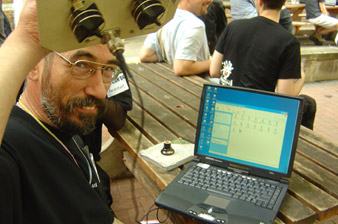
Reverend Rat demoed his 10-watt Bluetooth receiver, ten times more powerful than a 35-mile 802.11b receiver, and a hundred times more powerful than a Bluetooth dongle.
Not particularly interesting in itself, but from a high vantage point it might be used to map usage patterns in urban areas or track the flow of people and devices.
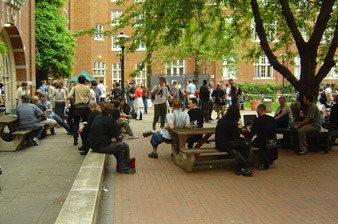
Some photos