Media
14 posts tagged.
-
CCD and computational photography
A few links on imaging and computation: from CCD by Joe Gregorio . Via BERG. from Computational Photography, American Scientist from What Photography Will Look Like By 2060
-
Augmentia
Anselm Hook , one of the founding thinkers of the geo-web, co-organiser of the first ARDevCamp at the Hacker Dojo in Mountain View late last year, lays out the emerging issues with Augmented Reality. He relates it to a whole host of known and unknown problems around ubiquitous computing, semantic publishing and data platforms. A few passages worth holding on to:
-
Embodied interaction in music
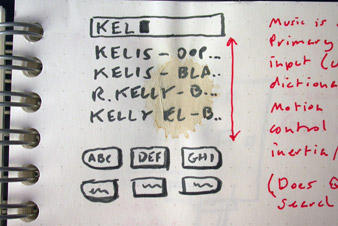
A set of sketches from Easter 2005 on navigating music on portable devices, written after switching from a 40GB iPod to the iPod Shuffle. The clickwheel doesn’t cut it on huge alphabetical lists. The sketches try predictive text input, squeeze-and-shake movement, audio scrubbing and gestures like covering an ear to switch tracks.
-
Art + communication 2004
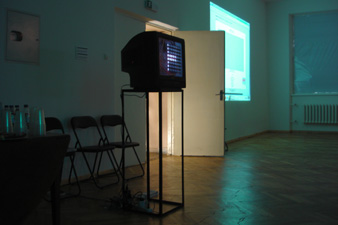
Notes from Art + Communication 2004, organised by RIXC in Riga, Latvia, the final event in the Trans-cultural Mapping workshop series. Even Westvang and I presented our Timeland project. A trip to Limbazi for the opening of the Piens (‘milk’) project, milk routes through the EU, mapped through the personal stories of the people along them.
-

ISEA 2004 conference
A short 2004 note from ISEA, the International Symposium on Electronic Art, held that year on a Silja Line ferry between Helsinki, Stockholm, Mariehamn and Tallinn. Polarfront kept event notes through the run, and Grandtextauto covered the installations and artwork.
-
Mobile outskirts workshop
A bus full of GPS receivers, cameras and impromptu artworks drove fifteen hours from Trondheim up to the islands of Lofoten. The workshop wiki and media archive are being kept updated via fairly limited wireless coverage. A short dispatch from the Mobile Outskirts workshop in Lofoten, June 2004, part of the Trans-cultural Mapping workshop series . A painless and creative bus drive up the Norwegian coast.
-
Outside In
Outside In was a two-day forum at Röda Sten in Gothenburg on 14–15 June 2004, about new voices, media and practices in the design and use of public space. The venue is extraordinary: below a suspension bridge, surrounded by huge concrete creations. Really windy outside, calm inside the lecture space. These are my notes from the talks, written on the day. Occasional asides in italics are things I’ve added looking back. I’ve left the note form mostly as-is. (I missed the first workshop of the day.) Putting memories in spaces. Spaces aren’t the same after having been disrupted. After ‘Reclaim the Streets’ or a Circle Line party you can’t see the space in the same way. Distinction between public and private. What is it? Public space doesn’t exist anymore. Ken Livingstone’s new City Hall is half-private, half-public, private investment was involved in the building, so protests cannot happen outside. Do we need institutions in order to do events? Is that the only way to do them legally? What’s stopping people from doing these things is not necessarily capitalism but the fear of looking like a pillock. Self-regulation is a big factor. Can spark things to let down inhibitions or shackles. Example of the scooter, became a kids’ toy and then it wasn’t cool anymore.
-
Notcon 04
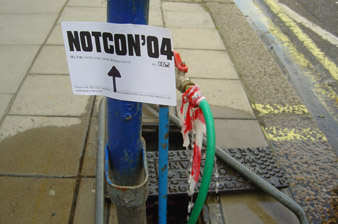
Two things from Notcon 04 in London worth writing up: Spotcodes, very simple circular barcodes readable with a Series 60 camera phone, storing 42 bits of data and usable for positional tracking; and Reverend Rat’s 10-watt Bluetooth receiver, a hundred times more powerful than a Bluetooth dongle.
-
Mobile social software applications
A list of mobile social software applications from 2004: Jabberwocky tracking familiar strangers, Fluidtime routing public transport in Turin, Dodgeball pinging your friends when they’re within ten blocks of you, Plazes tagging your location for the public, Mamjam chatting with others at the same venue by SMS. The first wave of location-aware social services, before smartphones. A growing list I compiled in June 2004 during early PhD research into mobile and locative systems. Descriptions below are taken from each project’s own site. Most of the projects are long gone; the list is preserved as a snapshot of what mobile social software looked like before the iPhone. Companion to the spatial annotation projects list . This research project explores our often ignored yet real relationships with Familiar Strangers. We describe several experiments and studies that lead to a design for a personal, body-worn, wireless device that extends the Familiar Stranger relationship while respecting the delicate, yet important, constraints of our feelings and relationships with strangers in pubic places. A visualization tool based on Mobster that enables users to explore their social encounters in new ways.
-

Travelogue
A 2004 note on treating digital photography as a narrative medium, sequences of photos that suggest movement, place, stories and journeys. With plans to tag each image with a GPS coordinate so the sequence carries place as well as time.
-
Design for television
Eighteen points as a minimum type size, if you’re coming from a web background, equates to about 18 pixels. On some interactive television projects I’ve pushed it down to 16, but cautiously, because the production path to air usually punishes small type: DV tape, old composite links, online-edits with high compression. Leave type as large as the design will bear. Notes written in response to David Earls at Typographer.org, who had covered the basics of designing for television and prompted me to add a few things specific to interactive television, which I’d been working on at the time. In some cases (white text on a red background, for instance) a very subtle black drop-shadow will stop colour bleed and crawling effects. Even if you dislike drop-shadows, a subtle one will look flat and lovely on a broadcast monitor. Safe areas need to be taken with a pinch of salt. The default safe areas in most editing and compositing software date from before the widespread use of widescreen sets. Try extending the safe area for non-essential text in interactive projects, and consult broadcaster guidelines for their widescreen policies: many channels now broadcast in 14:9 to terrestrial boxes, with options for satellite and cable viewers.
-
Media theory books
This is one of a series of reading lists I put together between 2002 and 2004 when I was starting out in interaction and experience design, building out a personal canon from books I was buying, borrowing from libraries, or lending to students. The lists are grouped by topic. This one is media theory: how new media remakes old assumptions, the politics of the networked commons, and the relationships between people, computers and media. Manovich’s Language of New Media is the canonical starting point. Lessig’s The Future of Ideas is the political counterpart. Reeves & Nass’s The Media Equation is the one that stays with you, a readable empirical argument that we treat machines socially whether we mean to or not. Paul Taylor’s Hackers sits slightly to one side of the others; it’s the best academic treatment of hacker culture I know. The Amazon links below are what I had at the time, most will be dead now, but the ISBNs will find you a copy. Lev Manovich. amazon.co.uk / amazon.com Hubert Dreyfus. amazon.co.uk / amazon.com Lawrence Lessig. amazon.co.uk / amazon.com Paul Taylor. amazon.co.uk / amazon.com An extraordinary insight into hacker culture – academically rigorous but very readable and entertaining.
-
Narrative books
This is one of a series of reading lists I put together between 2002 and 2004 when I was starting out in interaction and experience design, building out a personal canon from books I was buying, borrowing from libraries, or lending to students. The lists are grouped by topic. This one is on narrative: interactive storytelling, theatre as a model for interaction, story structure, and the sequential-art tradition of comics. Janet Murray’s Hamlet on the Holodeck and Brenda Laurel’s Computers As Theatre are the two foundational texts that frame interaction design as a narrative practice. Campbell’s The Hero with a Thousand Faces is the story-structure canon. And Scott McCloud’s Understanding Comics, along with Eisner’s books, are among the most useful things an interaction designer can read, more practical than most HCI books for thinking about pacing, framing, and the relationship between words and images. The Amazon links below are what I had at the time, most will be dead now, but the ISBNs will find you a copy. Janet H Murray. amazon.co.uk / amazon.com Mark Stephen Meadows. amazon.co.uk / amazon.com Brenda Laurel. amazon.co.uk / amazon.com Joseph Campbell. amazon.co.uk / amazon.com
-
Honeysphere collaborative storytelling platform
A 1999 student project at Central Saint Martins, London, by a team of six including me and Jack Schulze . Interactive television, in 1999, meant set-top boxes with return channels, BSkyB’s OpenTV platform, and WebTV. The project won the London Institute Award for Innovation. We presented our findings to the public at the Berlin Film Festival in February 2000. A platform for collaborative storytelling on interactive television, audience members contributing to an unfolding narrative through a shared interface, rather than passively watching a broadcast. A small team at Central Saint Martins researched the state of the field: existing web-based projects in community, gaming, multi-user space, and interactive narrative. The output was a research archive and a set of design patterns for collaborative television software.