Television
7 posts tagged.
-
Design for television
Eighteen points as a minimum type size, if you’re coming from a web background, equates to about 18 pixels. On some interactive television projects I’ve pushed it down to 16, but cautiously, because the production path to air usually punishes small type: DV tape, old composite links, online-edits with high compression. Leave type as large as the design will bear. Notes written in response to David Earls at Typographer.org, who had covered the basics of designing for television and prompted me to add a few things specific to interactive television, which I’d been working on at the time. In some cases (white text on a red background, for instance) a very subtle black drop-shadow will stop colour bleed and crawling effects. Even if you dislike drop-shadows, a subtle one will look flat and lovely on a broadcast monitor. Safe areas need to be taken with a pinch of salt. The default safe areas in most editing and compositing software date from before the widespread use of widescreen sets. Try extending the safe area for non-essential text in interactive projects, and consult broadcaster guidelines for their widescreen policies: many channels now broadcast in 14:9 to terrestrial boxes, with options for satellite and cable viewers.
-
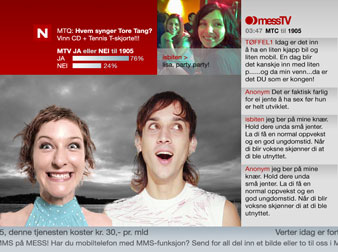
Mess TV: SMS and MMS community television
A nightly community TV show on TV Norge, running from 2am to noon the next day, carried largely by SMS and MMS messages submitted from mobile phones. I rebranded the show against the TV Norge visual identity, refined the SMS and MMS interaction scenarios, and advised on linear broadcast and interactive content.
-
Broadcast design books
This is one of a series of reading lists I put together between 2002 and 2004 when I was starting out in interaction and experience design, building out a personal canon from books I was buying, borrowing from libraries, or lending to students. The lists are grouped by topic. This one is on motion graphics and broadcast design, a parallel craft I’d been working in, and one that feeds directly into time-based interaction work. Richard Williams’s The Animator’s Survival Kit is the single essential craft book on the shelf, worth more than all the others combined if you only read one. Bellantoni & Woolman’s Type in Motion is the theoretical book I kept returning to. The Meyers’ After Effects books were the practical manuals of the era; much of their content is now superseded, but they taught a generation how to think about motion. The Amazon links below are what I had at the time, most will be dead now, but the ISBNs will find you a copy. Julie Hirschfeld, Stefanie Barth ed. amazon.co.uk / amazon.com Robert Klanten, Hendrik Hellige, Birga Meyer. Includes 4 ½ hours of motion graphics work on DVD, but the book itself is disappointing. amazon.co.uk / amazon.com Jeff Bellantoni, Matt Woolman. amazon.co.uk / amazon.com
-
Film books
This is one of a series of reading lists I put together between 2002 and 2004 when I was starting out in interaction and experience design, building out a personal canon from books I was buying, borrowing from libraries, or lending to students. The lists are grouped by topic. Film has always been a neighbouring discipline, and this list is about the craft: directing, editing, sound, screenwriting, the architecture of the frame. Bordwell & Thompson’s Film Art is the textbook every interaction designer should also read: how scenes work, how cuts work, how attention works. Tarkovsky’s Sculpting In Time and Kieslowski on Kieslowski are the directors’ own accounts of their thinking. Michel Chion’s Audio Vision is the essential book on sound-image relationships; I keep returning to it. Lumet’s Making Movies is the working director’s how-to. The Amazon links below are what I had at the time, most will be dead now, but the ISBNs will find you a copy. David Bordwell, Kristin Thompson. Classic textbook, required reading. amazon.co.uk / amazon.com Andrey Tarkovsky. amazon.co.uk / amazon.com Andrey Tarkovsky. amazon.co.uk / amazon.com Danusia Stok, Krzysztof Kieslowski. A thorough insight into Kieslowski’s process, thinking and ideology. Wonderful.
-
Narrative books
This is one of a series of reading lists I put together between 2002 and 2004 when I was starting out in interaction and experience design, building out a personal canon from books I was buying, borrowing from libraries, or lending to students. The lists are grouped by topic. This one is on narrative: interactive storytelling, theatre as a model for interaction, story structure, and the sequential-art tradition of comics. Janet Murray’s Hamlet on the Holodeck and Brenda Laurel’s Computers As Theatre are the two foundational texts that frame interaction design as a narrative practice. Campbell’s The Hero with a Thousand Faces is the story-structure canon. And Scott McCloud’s Understanding Comics, along with Eisner’s books, are among the most useful things an interaction designer can read, more practical than most HCI books for thinking about pacing, framing, and the relationship between words and images. The Amazon links below are what I had at the time, most will be dead now, but the ISBNs will find you a copy. Janet H Murray. amazon.co.uk / amazon.com Mark Stephen Meadows. amazon.co.uk / amazon.com Brenda Laurel. amazon.co.uk / amazon.com Joseph Campbell. amazon.co.uk / amazon.com
-
Interaction and narrative workshop
Notes from a lecture given at Channel 4 in London in February 2002, as part of the Mesh Scheme for digital animation filmmakers. The lecture is aimed at designers and filmmakers thinking about how to make narratives that involve user or audience interaction. Ideologies, examples, processes and the practicalities of stories that aren’t linear. Full notes from the lecture are here .
-
Honeysphere collaborative storytelling platform
A 1999 student project at Central Saint Martins, London, by a team of six including me and Jack Schulze . Interactive television, in 1999, meant set-top boxes with return channels, BSkyB’s OpenTV platform, and WebTV. The project won the London Institute Award for Innovation. We presented our findings to the public at the Berlin Film Festival in February 2000. A platform for collaborative storytelling on interactive television, audience members contributing to an unfolding narrative through a shared interface, rather than passively watching a broadcast. A small team at Central Saint Martins researched the state of the field: existing web-based projects in community, gaming, multi-user space, and interactive narrative. The output was a research archive and a set of design patterns for collaborative television software.