AHO
8 posts tagged.
-
Immaterials: Satellite Lamps
Satellite Lamps reveals the invisible accuracy of GPS positioning across an urban landscape. Three lamps with built-in GPS receivers vary their brightness depending on signal accuracy, photographed over time to build a picture of how these signals behave in actual urban spaces.
-
Olars: physical toy inspired by karl sims evolved creatures
A lovely piece of work by Lars M. Vedeler and Ola Vågsholm from the Tangible Interactions course at The Oslo School of Architecture & Design: Olars on Vimeo
-
Immaterials: Ghost in the field
Ghost in the Field makes the field around an RFID reader visible. Long-exposure photography traces the volume in which a tag and reader can talk; outside that volume, the radio falls off and nothing happens. Made with Jack Schulze as part of the Touch project , 2009. More…
-
Sniff
Made with Sara Johansson and Einar Sneve Martinussen as part of the Touch project . Sniff is a soft toy dog that 'sniffs' and reacts to objects that come close to his nose. More…
-
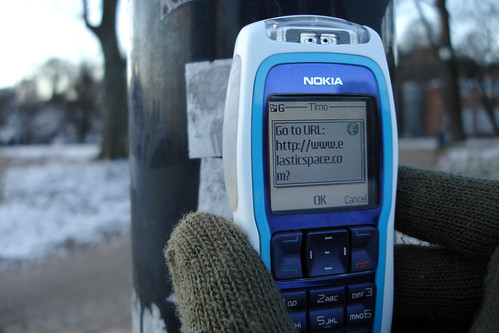
Touch
An AHO research project on what designers should do with NFC. Touch a phone to a tag, the tag answers, something happens. A phone call, an SMS, a URL. Funded by the Research Council of Norway, running since March 2006 with a project weblog at nearfield.org.
-
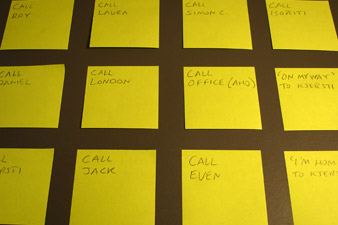
The address book desk
An early Touch-project experiment from December 2005. A grid of RFID tags stuck under the desk, mirrored by a grid of post-it notes on the surface, a phone-book, to-do list and temporary diary in one. Touching the phone to each post-it calls a contact, sends a pre-defined SMS or opens a URL.
-
Tangible and social interaction
On a Nintendo DS in a café, two people are sending each other stick-figure drawings over PictoChat. On a TV in someone’s living room, four people are singing along to Singstar and making each other worse at it. At a bus stop in Berkeley, a phone is quietly logging which other phones it’s been near over the course of a day, a map of familiar strangers. Two lectures given at AHO in Oslo in January 2005, arguing that tangible and social interaction are the next chapter after the desktop. The PDF of the full presentation is here (1.9MB). Posted partly in response to Matt Jones and Chris Heathcote ‘s ETech presentation ( notes , link restored from Wayback). (Based on Dourish, see reading recommendations below.) Each successive development in computer history has made greater use of human skills: Electrical : required a thorough understanding of electrical design Symbolic : required a thorough understanding of the manipulation of abstract languages Textual : text dialogue with the computer, which set the standards of interaction we still live with today Graphic : graphical dialogue with the computer, using our spatial skills, pattern recognition, and motion memory with a mouse and keyboard
-
Sound objects
A box sits on the desk, with no markings on its surface. Touch it with a finger and the box makes a sound, impact, friction, deformation, depending on where you touch. There are soft buttons on the surface, but you can’t see them. You hear them. Notes from Mikael Fernström’s lecture at AHO in February 2005. Fernström runs the Interaction Design Centre at the University of Limerick, where the Soundobject project is working on sound in ubiquitous computing, a relatively unexplored area of interaction design. The aim of the Soundobject research is to liberate interaction design from visual dominance, to free up the eyes, and to do what small displays don’t do well. Sound is currently under-utilised in interaction design Vision is overloaded and our auditory senses are seldom engaged In the world we are used to hearing a lot Adding sound to existing, optimised visual interfaces does not add much to usability Sound is good at attracting attention, which is why alarms and notification systems work. We talked about ‘caller groups’ on mobile phones, assigning different ringtones to people in an address book, and how effectively that changes our relationship with our phones.