Adaptive Design
10 posts tagged.
-

Spatial memory at Design Engaged 2004
Presentation notes from Design Engaged 2004 in Amsterdam. Two related strands: the Time that land forgot project with Even Westvang (five months, 8000 photos, visualised by date and time of day), and the research on marking in urban public space.
-
Design Engaged 2004
Twenty-odd designers, researchers and writers sat around a long table in Amsterdam over a weekend in November 2004, taking turns to present. These are my notes, session-by-session, as written at the time. Design Engaged 2004 was an invitation-only gathering organised by Andrew Otwell. A small, intense weekend of conversation that turned out to be one of the generative moments of the design-web at that period. The FAQ has the full list of attendees. There are also lots of photos on Flickr . The growth of the soil How do we comprehend complexity How do we build structures around complex information Accreting meta-data: GPS data, descriptive information Break down of material as it hits the soil Soup, tags, condensed and distilled meta objects Sorting mechanisms, affinity browsers, related, filtering, emergent relationships, interrelationships How do we conceive a metaphor for building these processes? A structure that is meaningful for the users. Application design: movement through states of application to tending a flow of processes Tending to meta-data is a growth process DLA: diffusion-limited aggregation, a natural process model The relationships between metadata can be visualised as this.
-
Physical computing workshop
Notes from the ‘Making Sense’ physical computing workshop at Atelier Nord in Oslo, September 2004, organised by Erich Berger with Helen Evans and Heiko Hansen of HeHe. The intention was to avoid the screen entirely, to concentrate on simple interactions between sensors and outputs. But here we are, staring at PBasic and JAL while making lots of LEDs blink.
-
Design research books
This is one of a series of reading lists I put together between 2002 and 2004 when I was starting out in interaction and experience design, building out a personal canon from books I was buying, borrowing from libraries, or lending to students. The lists are grouped by topic. This is the last and shortest list on the shelf, the one on design research as a practice. Norman Potter’s What is a designer and Models and Constructs are the two books that deserve to be read more than they are, compact, sharp and more relevant to design education than most larger textbooks. Brenda Laurel’s Design Research: Methods and Perspectives is the practical anthology. Miller & Lupton’s Design Writing Research is the critical and editorial companion, how design thinking becomes design writing. The Amazon links below are what I had at the time, most will be dead now, but the ISBNs will find you a copy. Norman Potter. amazon.co.uk / amazon.com Norman Potter. amazon.co.uk / amazon.com Brenda Laurel Ed. amazon.co.uk / amazon.com Abbott Miller, Ellen Lupton. amazon.co.uk / amazon.com Jessica Helfand. amazon.co.uk / amazon.com
-
Social filtering for online forums
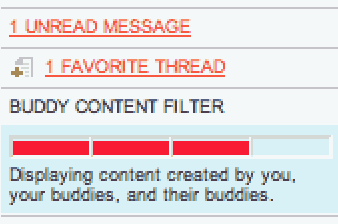
Yayhooray relaunched in June 2004 with a new version that uses social filtering to raise signal-to-noise. As far as I know, this is the first forum to use the buddy list as content filter. A short history of online-forum filtering approaches, and notes on what the new Yayhooray does.
-
Creative Crossings workshop
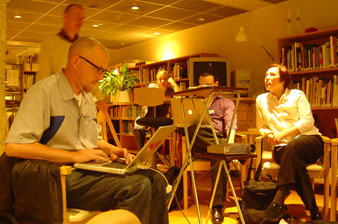
A triangular research network, practitioners from Britain, Canada and Finland, gathered in London to work on participatory and creative applications for mobile, locative and cross-platform media. Organised by m-cult, the Banff Centre and Arts Council England in April 2004.
-
Interaction design books
This is one of a series of reading lists I put together between 2002 and 2004 when I was starting out in interaction and experience design, building out a personal canon from books I was buying, borrowing from libraries, or lending to students. The lists are grouped by topic. This is the interaction design shelf itself, and the one where I’ve annotated most of the entries in the original post. Jef Raskin’s The Humane Interface is the one absolutely essential book on this shelf; read it first, and read it more than once. Alan Cooper’s The Inmates Are Running the Asylum is the polemical companion. Lucy Suchman’s Plans and Situated Actions is the theoretical counterpoint, an anthropologist’s argument that interaction is situated in context, not specified in plans. Bergman’s Information Appliances and Beyond is the best case-study collection I know. The Amazon links below are what I had at the time, most will be dead now, but the ISBNs will find you a copy. Pink = highly recommended! Eric Bergman ed. One of the best interaction design books to date. With case-studies on various design problems from Palm OS usability to Nokia contextual design issues. Just enough detail and anecdotes to get a good sense of design process. amazon.co.uk / amazon.com
-
Adaptive design books
This is one of a series of reading lists I put together between 2002 and 2004 when I was starting out in interaction and experience design, building out a personal canon from books I was buying, borrowing from libraries, or lending to students. The lists are grouped by topic. This one is on adaptive design: emergence, pattern languages, the design of things that learn or evolve, and the classics on how cities and communities organise themselves. Christopher Alexander is the spine of this shelf, from Notes on the Synthesis of Form through A Pattern Language to The Nature of Order. Stewart Brand’s How Buildings Learn is the architectural companion. Jane Jacobs’s Death and Life of Great American Cities is the urban-planning foundation. Steven Johnson’s Emergence and Mitchel Resnick’s Turtles, Termites, and Traffic Jams are the approachable modern introductions to complex adaptive systems. Rheingold’s Smart Mobs is the early-2000s prediction of networked collective behaviour that mostly came true. The Amazon links below are what I had at the time, most will be dead now, but the ISBNs will find you a copy. Christopher Alexander. amazon.co.uk / amazon.com Christopher Alexander. amazon.com
-
Design management books
This is one of a series of reading lists I put together between 2002 and 2004 when I was starting out in interaction and experience design, building out a personal canon from books I was buying, borrowing from libraries, or lending to students. The lists are grouped by topic. This one is the shortest on the shelf and the most practical, the books on managing design projects, gathering requirements and running workflows. The Robertsons’ Mastering the Requirements Process is the standard reference on requirements gathering. Karl Wiegers’s Software Requirements is the software-engineering equivalent. Goto & Cotler’s Web Redesign is of its moment but it was the manual every web-design studio had on a shelf in 2003. The Amazon links below are what I had at the time, most will be dead now, but the ISBNs will find you a copy. Suzanne Robertson, James Robertson. amazon.co.uk / amazon.com Karl E. Wiegers. amazon.co.uk / amazon.com Jessica Burdman. amazon.co.uk / amazon.com Kelly Goto, Emily Cotler. amazon.co.uk / amazon.com Steve McConnell. amazon.co.uk / amazon.com
-
Experience design books
This is one of a series of reading lists I put together between 2002 and 2004 when I was starting out in interaction and experience design, building out a personal canon from books I was buying, borrowing from libraries, or lending to students. The lists are grouped by topic. This one is on experience design itself, the books that were building the vocabulary for the field at the time. Jesse James Garrett’s The Elements of User Experience is still the clearest practitioner’s framework. Dewey’s Art as Experience from the 1930s is the philosophical foundation; the chapter called ‘What is an experience’ is worth reading on its own. Csikszentmihalyi’s Flow is the psychological counterpart. James Cousins’s British Rail Design, out of print, is a fascinating case study of integrated experience design across every touchpoint of a service, from seat-fabric to signage. The Amazon links below are what I had at the time, most will be dead now, but the ISBNs will find you a copy. Jesse James Garrett. This small book succinctly and professionally explains the entire user-experience field. Every page has some insight to offer; from user-centred strategy to visual branding and graphics. For more information see jjg.net . amazon.co.uk / amazon.com