Suwappu
Suwappu is a set of small stackable two-piece woodland-animal toys whose tops and bottoms can be swapped between species. The toys come to life through a phone camera held above them. Films and stories play out in augmented space around each character, while the toys themselves stay physical, on the table or in the hand. Made at BERG for Dentsu London, 2011.
Introducing Suwappu. Directed by Timo Arnall and Jack Schulze, BERG / Dentsu, April 2011.
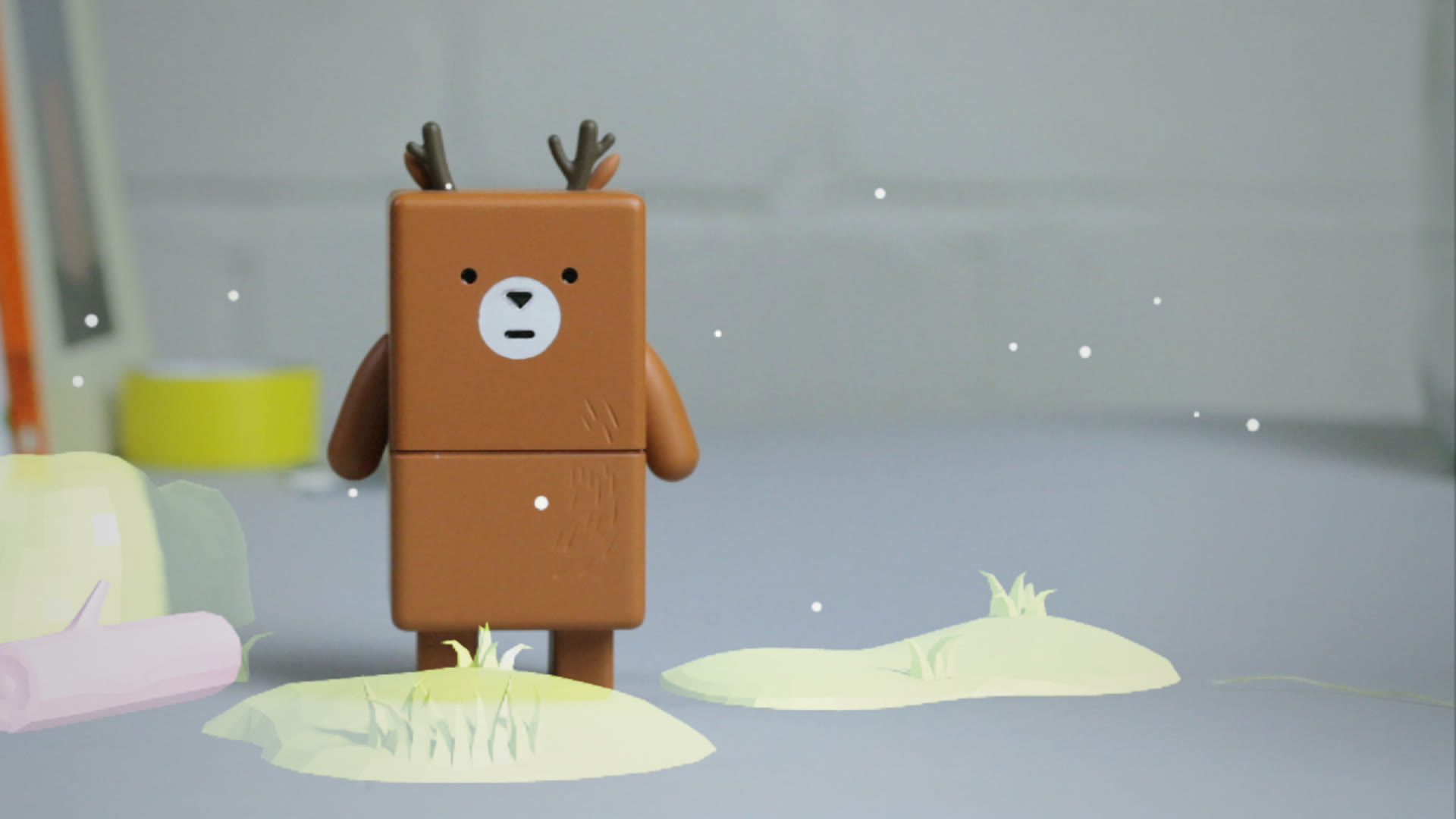
Five characters made up the cast. Badger lived in a harsh, troubled world. Deer in a forest utopia. Fox in an urban garden. Tuna in a paddling pool of nicely rendered water. Each toy was the same physical object — a stacking pair of moulded plastic blocks with a face printed on top — and each carried its own world inside it, surfaced by a camera held above. Pop the head off one and put it on another and the species changed; the world changed too.
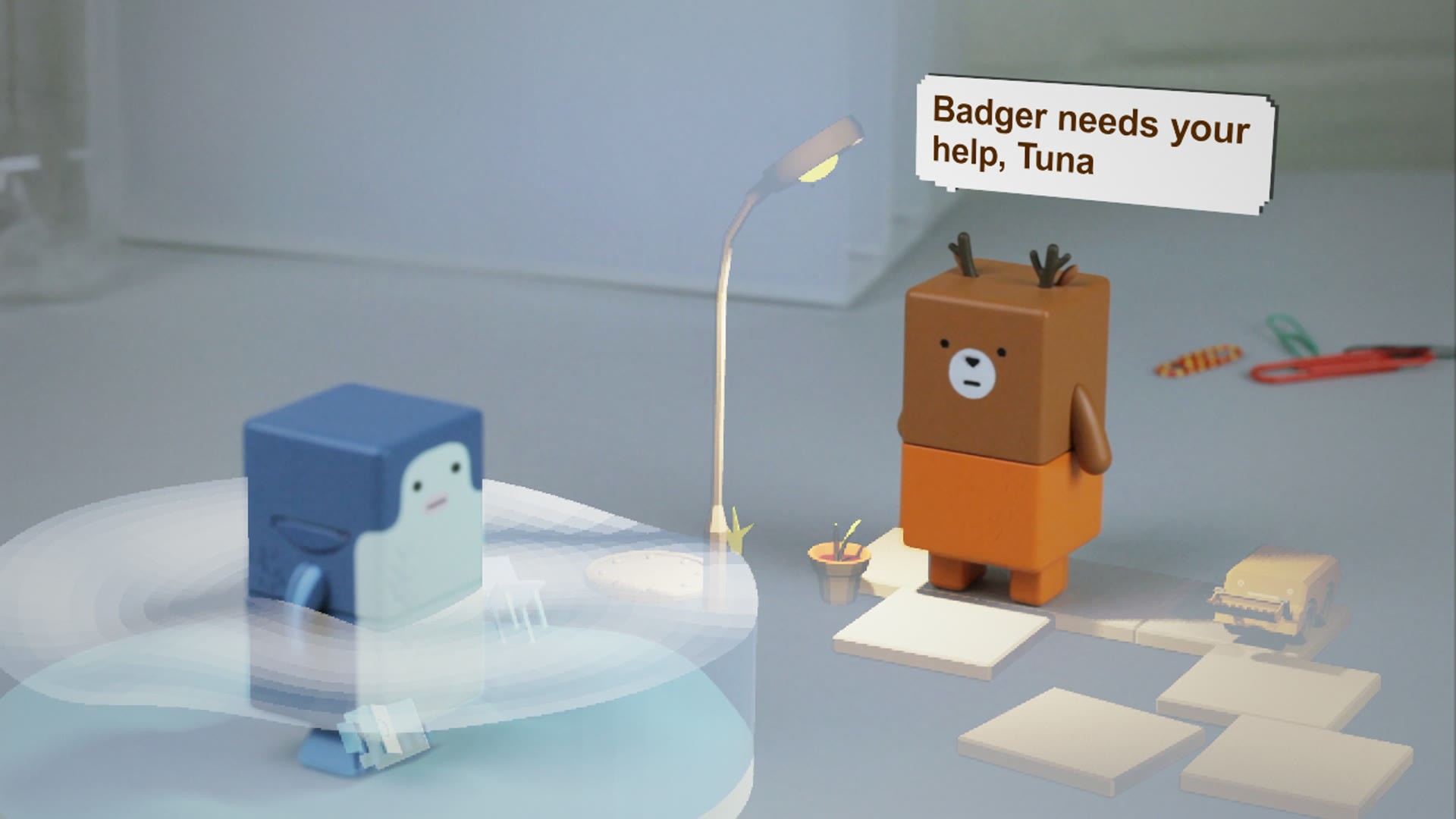
The toys themselves were the markers. Each character’s printed pattern was distinct enough that the camera could identify which species it was looking at and its rough orientation, without needing a fiducial barcode or QR code spoiling the design. That meant the toy could be a toy first — handled, given to a child, swapped piece-for-piece with another toy — and the augmented layer could attach itself when a phone happened to be nearby. The films, the speech bubbles, the rendered habitats: all of that lived in software, attached to the toys via the phone.
The pattern recognition was a hand-tuned implementation written specifically for the printed forms, well before ARKit or ARCore existed; today the same idea would be a few lines of CoreML. At the time it was a small piece of computer-vision craft built on OpenCV and a custom training set.
Production
Directed by Jack Schulze and me. Character design by Camille Bozzini. The toy industrial design and the moulds were developed at BERG. The films were shot in the studio with the toys on a tabletop and the augmented elements composited in After Effects against the camera’s plate. The pattern-recognition software ran on iPhone hardware of the time. Dentsu London commissioned and produced.
Selected coverage
Suwappu was acquired into MoMA’s Talk to Me exhibition (24 July to 7 November 2011), curated by Paola Antonelli, alongside four other works of mine: Immaterials: Ghost in the Field, Nearness, Media Surfaces, and The Journey. Fast Company wrote about it. Original launch posts on BERG’s blog and an app-prototype follow-up describe the project further.
Suwappu was made at BERG (London) by Jack Schulze and Timo Arnall, with character design by Camille Bozzini, for Dentsu London. With thanks to the BERG studio and to Dentsu’s creative team.