Immaterials: Light Painting WiFi
Immaterials: Light Painting WiFi is a film and photography project that makes the spatial shape of WiFi networks visible. We walked a four-metre measuring rod with eighty individually-controlled lights through Grünerløkka, Oslo, in winter 2010–2011. The rod registered local WiFi signal strength as it moved; long-exposure photographs traced its path. The result is a series of pictures and a film in which the radio fields you walk through every day appear as standing walls and ridges of light.
Immaterials: Light Painting WiFi. YOUrban + Touch projects, 2011.
The work was made with Einar Sneve Martinussen and Jørn Knutsen, my colleagues at AHO in Oslo, as part of the YOUrban research project. It built directly on the methods we’d developed for Immaterials: Ghost in the Field with Jack Schulze in 2009 — long-exposure photography as a way of physically tracing the grain of an invisible technology. The earlier work used an RFID probe at small scale; this one used a much taller probe in the open city.
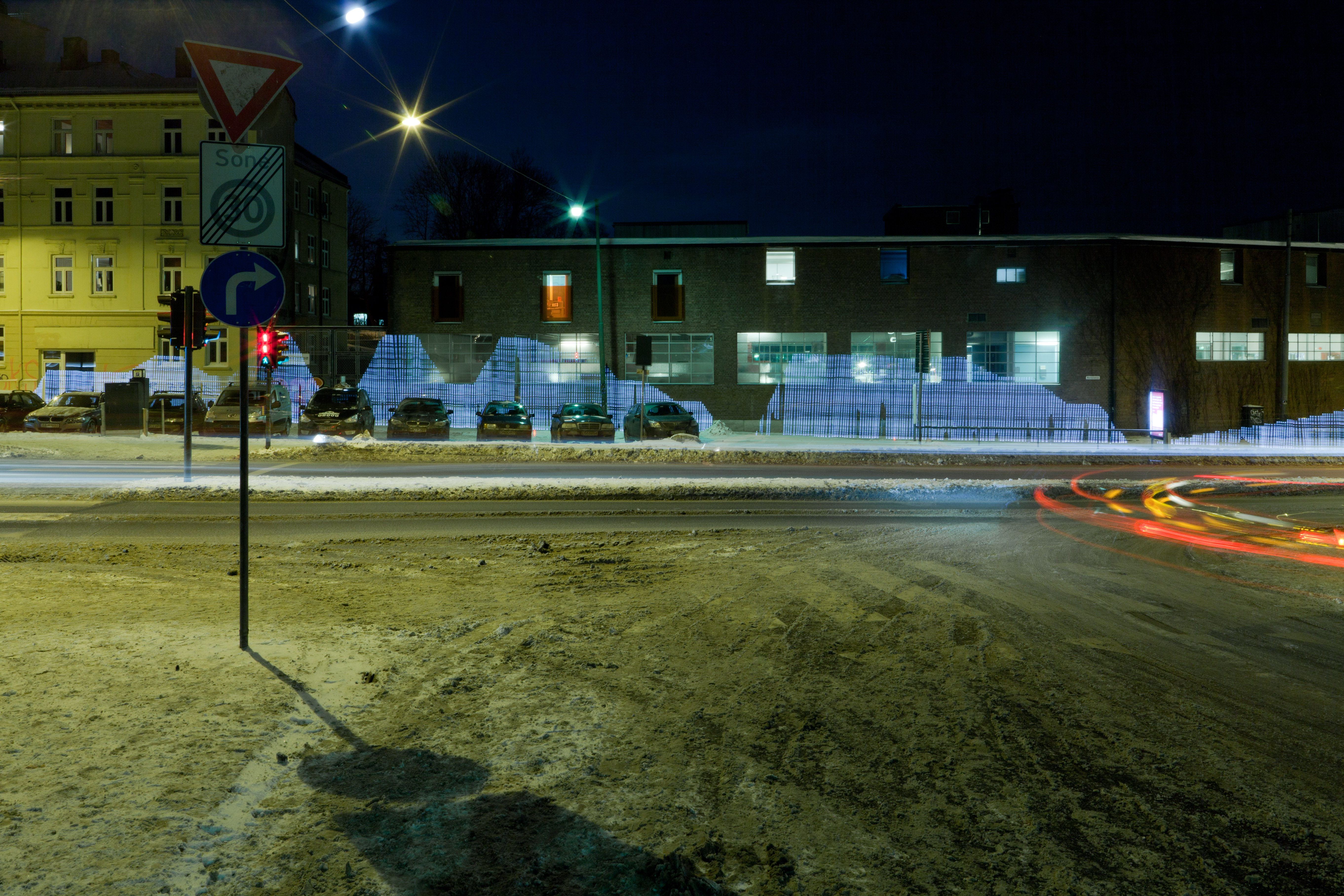
The rig itself is straightforward. Eighty individually-addressable LEDs along a four-metre aluminium rod. A small computer that polls the wireless network signal strength about ten times a second and sets the brightness of each LED in proportion. Hold the camera shutter open for a long exposure, walk the rod through the scene at a steady pace, and the LEDs draw a vertical slice of the field as they move horizontally. Several slices stitched together describe a section through the city.
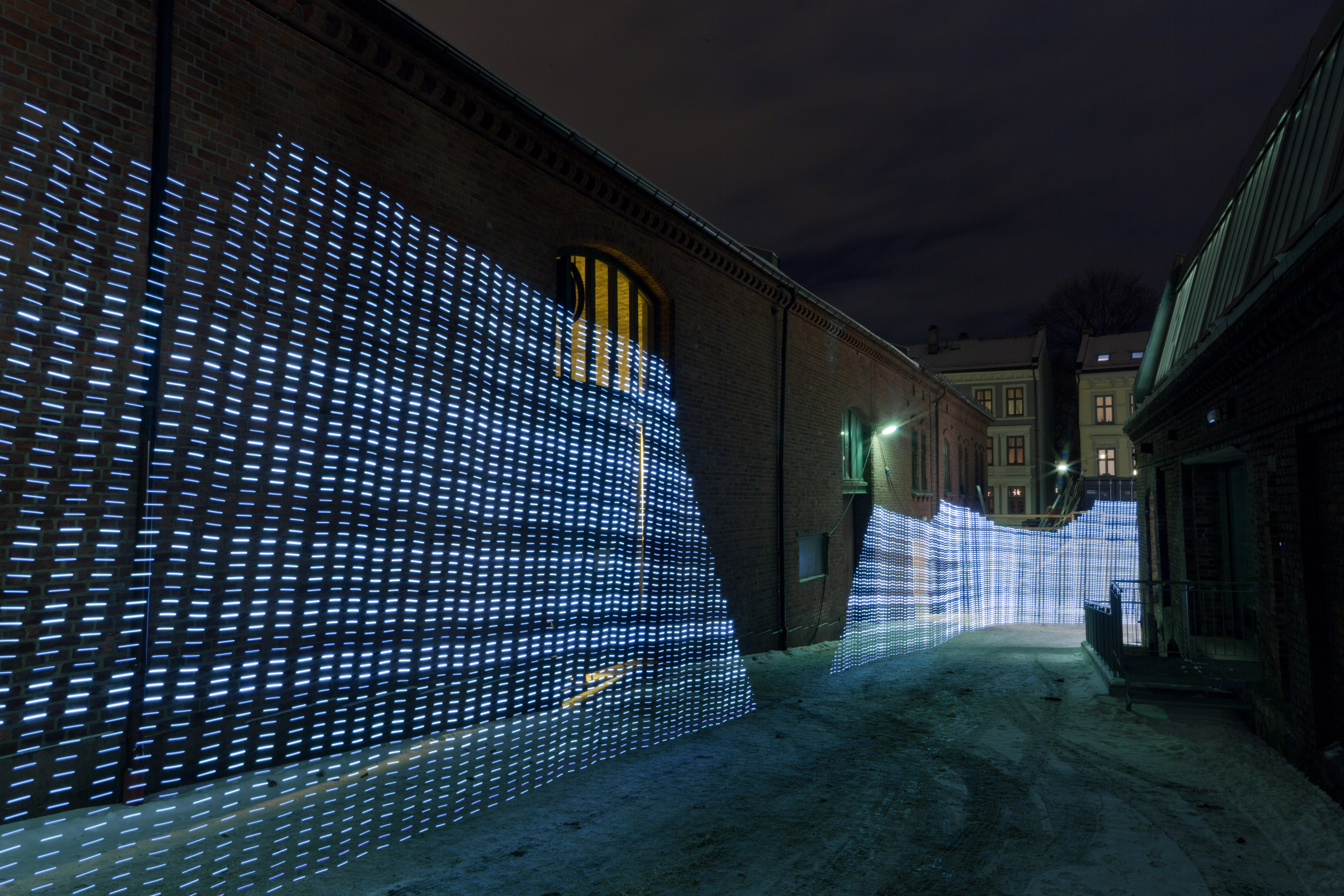
What the photographs show, more than anything, is that WiFi has a shape. It has hills and valleys, dense zones and gaps, edges where the signal cuts off against a wall and seeps around a corner. The shape changes minute to minute, with people moving and devices switching on. It interacts with the city the way light interacts with a forest: pooling in some places, blocked in others, leaking around obstacles. The visualisation is true to the technology in a way that a heatmap on a phone screen never quite is.
Reach and adoption
The film and photographs travelled further than I expected. Light Painting WiFi was a finalist at the Vimeo Awards 2012. The Royal Statistical Society’s journal Significance ran a peer-reviewed article on the work, framing it for a statistics audience as a new kind of real-space, real-time data visualisation. Fast Company / Co.Design called it ‘a delightful fusion of low and high-tech’. Make Magazine wrote it up as a maker piece; Kevin Holmes at Vice / Motherboard, Laughing Squid, SlashGear and FlowingData all covered the work in the same week of release. The visual technique was subsequently adopted by the BBC and the Discovery Channel, and extended in research at MIT and CIID. Bruce Sterling covered the work in Wired Beyond the Beyond in 2014; the YOUrban project tracked the film’s propagation through traditional press, design blogs, awards, books, and academic literature in a long roundup.
The work was exhibited in the survey show Immaterials at Lighthouse, Brighton, in September–October 2013, alongside Ghost in the Field, Wireless in the World, Robot Readable World and Satellite Lamps.
Immaterials: Light Painting WiFi was made by Timo Arnall, Jørn Knutsen and Einar Sneve Martinussen at AHO Oslo in 2011, as part of the YOUrban research project. With thanks to BERG, the Touch project, and to everyone who walked the rod through Grünerløkka in the cold.