Social
10 posts tagged.
-
Tangible and social interaction
On a Nintendo DS in a café, two people are sending each other stick-figure drawings over PictoChat. On a TV in someone’s living room, four people are singing along to Singstar and making each other worse at it. At a bus stop in Berkeley, a phone is quietly logging which other phones it’s been near over the course of a day, a map of familiar strangers. Two lectures given at AHO in Oslo in January 2005, arguing that tangible and social interaction are the next chapter after the desktop. The PDF of the full presentation is here (1.9MB). Posted partly in response to Matt Jones and Chris Heathcote ‘s ETech presentation ( notes , link restored from Wayback). (Based on Dourish, see reading recommendations below.) Each successive development in computer history has made greater use of human skills: Electrical : required a thorough understanding of electrical design Symbolic : required a thorough understanding of the manipulation of abstract languages Textual : text dialogue with the computer, which set the standards of interaction we still live with today Graphic : graphical dialogue with the computer, using our spatial skills, pattern recognition, and motion memory with a mouse and keyboard
-
Design Engaged 2004
Twenty-odd designers, researchers and writers sat around a long table in Amsterdam over a weekend in November 2004, taking turns to present. These are my notes, session-by-session, as written at the time. Design Engaged 2004 was an invitation-only gathering organised by Andrew Otwell. A small, intense weekend of conversation that turned out to be one of the generative moments of the design-web at that period. The FAQ has the full list of attendees. There are also lots of photos on Flickr . The growth of the soil How do we comprehend complexity How do we build structures around complex information Accreting meta-data: GPS data, descriptive information Break down of material as it hits the soil Soup, tags, condensed and distilled meta objects Sorting mechanisms, affinity browsers, related, filtering, emergent relationships, interrelationships How do we conceive a metaphor for building these processes? A structure that is meaningful for the users. Application design: movement through states of application to tending a flow of processes Tending to meta-data is a growth process DLA: diffusion-limited aggregation, a natural process model The relationships between metadata can be visualised as this.
-
Public marking photographs
A short September 2004 pointer to a Flickr set of images of stickering, graffiti and flyposting , supporting material for the research into spatial annotation. There’s an ever-updated selection under the “ marking ” tag on Flickr. See the Design Engaged 2004 presentation for fuller context.
-
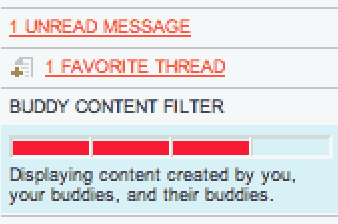
Social filtering for online forums
Yayhooray relaunched in June 2004 with a new version that uses social filtering to raise signal-to-noise. As far as I know, this is the first forum to use the buddy list as content filter. A short history of online-forum filtering approaches, and notes on what the new Yayhooray does.
-
Loop city workshop
Bill Hillier at University College London describes cities as movement economies, the structure of a city is the pattern of people moving through it. The workshop took this as the starting point and spent two days walking that idea across related fields: spatial organisation, relative space, time-space, taxicab geometry, mental mapping, text maps. Notes from the Loop City workshop at the Outside In symposium in Gothenburg, Sweden, June 2004. The workshop was led by Dietmar Offenhuber and Sara Hodges with participants from the symposium, working across geography, architecture, mapping and locative media. Raw notes below. spacesyntax.com Space explorers : children, homeless, vendors, skateboarders Space utilisers : commuters, workers Exocentric : external, connected Egocentric : centred, point of view Large, diverse research field Abler, Adams and Gould: Spatial Organization: The Geographer’s View of the World Expressing thematic data through spatial differentiation Political maps based on size of army Map of USA based on Elvis concerts Irina Vasiliev: Design Issues for Mapping Time Time as a way of measuring space (one conclusion: the world is shrinking) Grid systems make diagonal m…
-
Mobile social software applications
A list of mobile social software applications from 2004: Jabberwocky tracking familiar strangers, Fluidtime routing public transport in Turin, Dodgeball pinging your friends when they’re within ten blocks of you, Plazes tagging your location for the public, Mamjam chatting with others at the same venue by SMS. The first wave of location-aware social services, before smartphones. A growing list I compiled in June 2004 during early PhD research into mobile and locative systems. Descriptions below are taken from each project’s own site. Most of the projects are long gone; the list is preserved as a snapshot of what mobile social software looked like before the iPhone. Companion to the spatial annotation projects list . This research project explores our often ignored yet real relationships with Familiar Strangers. We describe several experiments and studies that lead to a design for a personal, body-worn, wireless device that extends the Familiar Stranger relationship while respecting the delicate, yet important, constraints of our feelings and relationships with strangers in pubic places. A visualization tool based on Mobster that enables users to explore their social encounters in new ways.
-

Spatial annotation projects
A reference list I compiled in June 2004 during early PhD research into locative media and spatial annotation. It includes Murmure in Vancouver’s Chinatown, Yellow Arrow stickers, Grafedia’s hyperlinked handwritten text, Urban Tapestries and dozens of others. The list is preserved as a snapshot of a field at a particular moment.
-
Adaptive design books
This is one of a series of reading lists I put together between 2002 and 2004 when I was starting out in interaction and experience design, building out a personal canon from books I was buying, borrowing from libraries, or lending to students. The lists are grouped by topic. This one is on adaptive design: emergence, pattern languages, the design of things that learn or evolve, and the classics on how cities and communities organise themselves. Christopher Alexander is the spine of this shelf, from Notes on the Synthesis of Form through A Pattern Language to The Nature of Order. Stewart Brand’s How Buildings Learn is the architectural companion. Jane Jacobs’s Death and Life of Great American Cities is the urban-planning foundation. Steven Johnson’s Emergence and Mitchel Resnick’s Turtles, Termites, and Traffic Jams are the approachable modern introductions to complex adaptive systems. Rheingold’s Smart Mobs is the early-2000s prediction of networked collective behaviour that mostly came true. The Amazon links below are what I had at the time, most will be dead now, but the ISBNs will find you a copy. Christopher Alexander. amazon.co.uk / amazon.com Christopher Alexander. amazon.com
-
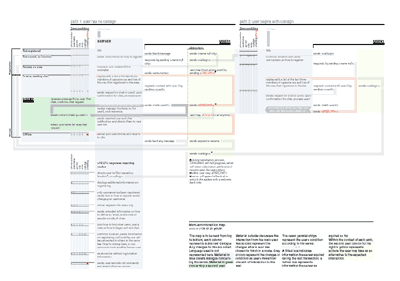
Mobile interaction design case study
A 2001 case study of consultancy work for Pollen Mobile, written up as it happened. Jack Schulze, Adi Nachman and I designed the interaction architecture for Mamjam, a location-based social entertainment service built on SMS, letting people in the same venue chat with each other by text.
-
Honeysphere collaborative storytelling platform
A 1999 student project at Central Saint Martins, London, by a team of six including me and Jack Schulze . Interactive television, in 1999, meant set-top boxes with return channels, BSkyB’s OpenTV platform, and WebTV. The project won the London Institute Award for Innovation. We presented our findings to the public at the Berlin Film Festival in February 2000. A platform for collaborative storytelling on interactive television, audience members contributing to an unfolding narrative through a shared interface, rather than passively watching a broadcast. A small team at Central Saint Martins researched the state of the field: existing web-based projects in community, gaming, multi-user space, and interactive narrative. The output was a research archive and a set of design patterns for collaborative television software.