Narrative
7 posts tagged.
-
Time that land forgot
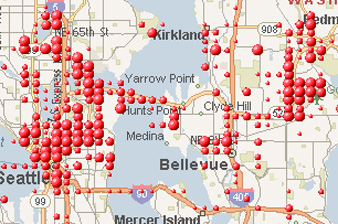
A 2004 project with Even Westvang from the Iceland inside-and-out workshop, a prototype for contextualising photographs by time and geography, designed to shift the balance of representation away from pure location and towards image and time.
-
Photography and mapping from Afar
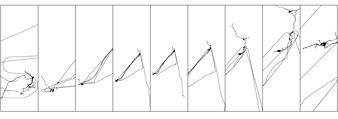
My contribution to ‘Afar’, an exhibition in Copenhagen where 25 international artists produced work to brief. For three months I recorded every walk, drive, train journey and flight I took while photographing daily life. Nine boards of images paired with GPS tracks drawn as simple lines show the transition from London to Oslo across a winter and spring.
-
Travelogue
A 2004 note on treating digital photography as a narrative medium, sequences of photos that suggest movement, place, stories and journeys. With plans to tag each image with a GPS coordinate so the sequence carries place as well as time.
-
Design for television
Eighteen points as a minimum type size, if you’re coming from a web background, equates to about 18 pixels. On some interactive television projects I’ve pushed it down to 16, but cautiously, because the production path to air usually punishes small type: DV tape, old composite links, online-edits with high compression. Leave type as large as the design will bear. Notes written in response to David Earls at Typographer.org, who had covered the basics of designing for television and prompted me to add a few things specific to interactive television, which I’d been working on at the time. In some cases (white text on a red background, for instance) a very subtle black drop-shadow will stop colour bleed and crawling effects. Even if you dislike drop-shadows, a subtle one will look flat and lovely on a broadcast monitor. Safe areas need to be taken with a pinch of salt. The default safe areas in most editing and compositing software date from before the widespread use of widescreen sets. Try extending the safe area for non-essential text in interactive projects, and consult broadcaster guidelines for their widescreen policies: many channels now broadcast in 14:9 to terrestrial boxes, with options for satellite and cable viewers.
-
Narrative books
This is one of a series of reading lists I put together between 2002 and 2004 when I was starting out in interaction and experience design, building out a personal canon from books I was buying, borrowing from libraries, or lending to students. The lists are grouped by topic. This one is on narrative: interactive storytelling, theatre as a model for interaction, story structure, and the sequential-art tradition of comics. Janet Murray’s Hamlet on the Holodeck and Brenda Laurel’s Computers As Theatre are the two foundational texts that frame interaction design as a narrative practice. Campbell’s The Hero with a Thousand Faces is the story-structure canon. And Scott McCloud’s Understanding Comics, along with Eisner’s books, are among the most useful things an interaction designer can read, more practical than most HCI books for thinking about pacing, framing, and the relationship between words and images. The Amazon links below are what I had at the time, most will be dead now, but the ISBNs will find you a copy. Janet H Murray. amazon.co.uk / amazon.com Mark Stephen Meadows. amazon.co.uk / amazon.com Brenda Laurel. amazon.co.uk / amazon.com Joseph Campbell. amazon.co.uk / amazon.com
-
Interaction and narrative workshop
Notes from a lecture given at Channel 4 in London in February 2002, as part of the Mesh Scheme for digital animation filmmakers. The lecture is aimed at designers and filmmakers thinking about how to make narratives that involve user or audience interaction. Ideologies, examples, processes and the practicalities of stories that aren’t linear. Full notes from the lecture are here .
-
Honeysphere collaborative storytelling platform
A 1999 student project at Central Saint Martins, London, by a team of six including me and Jack Schulze . Interactive television, in 1999, meant set-top boxes with return channels, BSkyB’s OpenTV platform, and WebTV. The project won the London Institute Award for Innovation. We presented our findings to the public at the Berlin Film Festival in February 2000. A platform for collaborative storytelling on interactive television, audience members contributing to an unfolding narrative through a shared interface, rather than passively watching a broadcast. A small team at Central Saint Martins researched the state of the field: existing web-based projects in community, gaming, multi-user space, and interactive narrative. The output was a research archive and a set of design patterns for collaborative television software.